11 Things to Hear for Winter Nature Study
You should hear the three great silences of winter: the wide, sudden silence that falls at twilight on the coming of the first winter frost; the smothered hush that waits the breaking of a winter storm; the crystal stillness, the speech of the stars, that pervades earth and sky on a brilliant, stirless winter night. You should hear — or is it feel? — them all.
Dallas Lore Sharp (Winter)
Over the last three years, I’ve been sharing the wonderful lists of nature goals from Dallas Lore Sharp’s seasons books. I started with things to see, then moved on to things to do, and this year has been things to hear. In this post, I’m sharing the final list: things to hear from his Winter book.
I appreciate these lists, especially for those who are new to nature study. In this day and age of constant activity and always “doing,” nature study, in its purest form of simply being in nature and observing, can (like Picture Study!) seem to be not enough, or too abstract. Sharp’s books offer simple goals that can start you down the path of making nature study a regular habit and allow you to see how simple it can be.
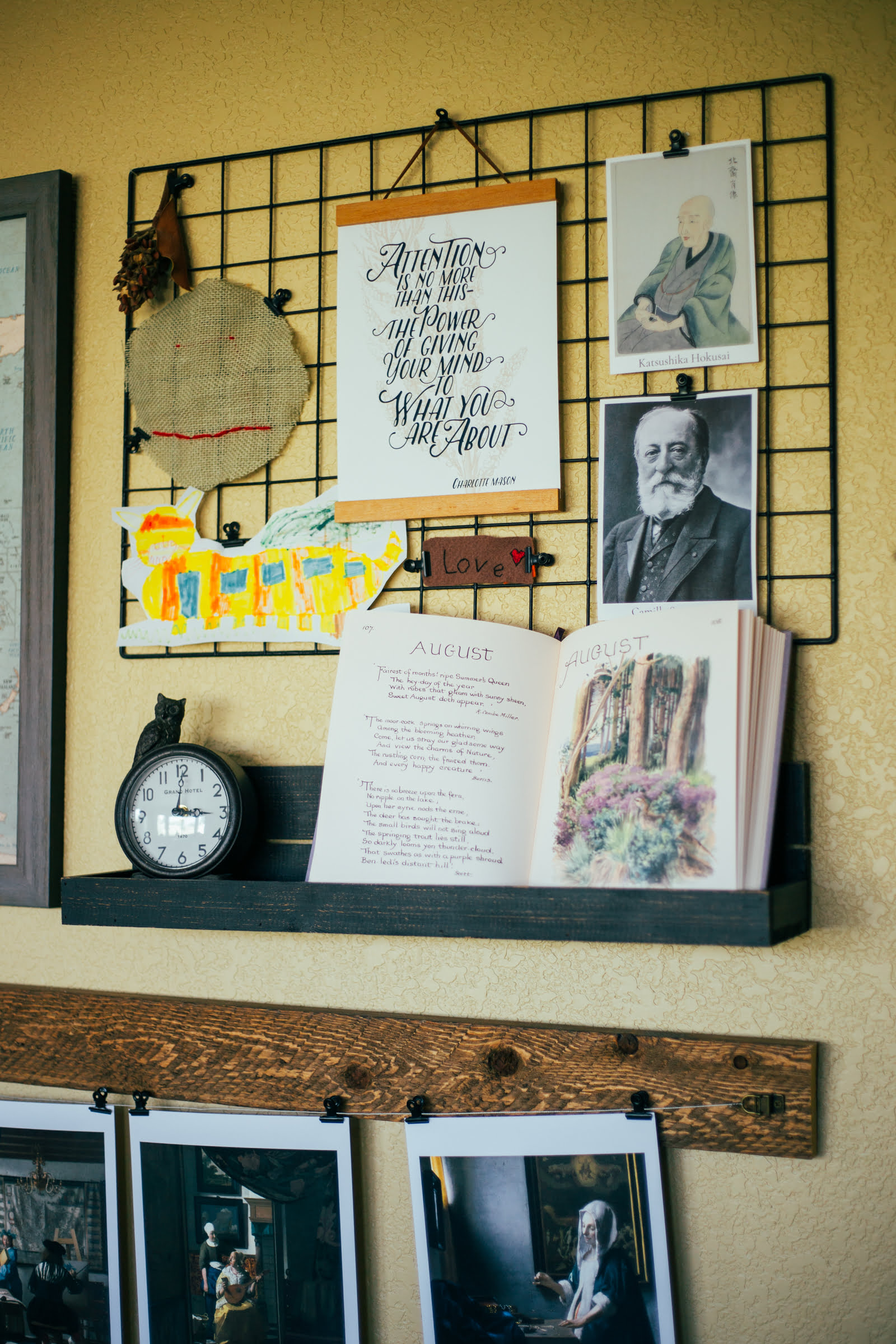
Even those of us who have been doing nature study for a while can find inspiration in them to, keep it simple. Charlotte Mason said:
We are awaking to the use of nature-knowledge, but how we spoil things by teaching them! We are not content that children should know the things of nature as we know our friends, by their looks and ways, an unconscious comprehensive knowledge which sinks in by dint of much looking, but we set them to fragmentary scraps of scientific research. They intend investigation, and lose the joy of seeing. Their attention is concentrated upon this or that, and they lose the all-round alertness which is the chief equipment of the nature-student. We shall awake some day and find that nature-study, as we have taught it, adds not at all to the joy of life.
Charlotte Mason (Formation of Character, p. 395)
Sharp’s lists truly are so simple and allow us to keep the joy of seeing.
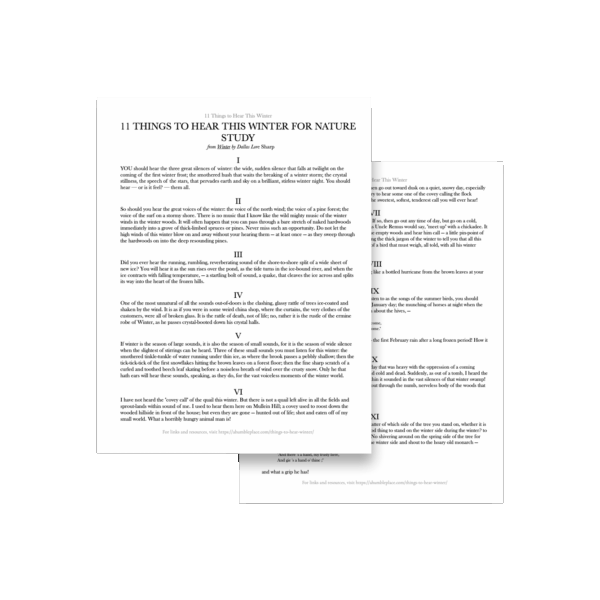
11 Things to Hear for Winter Nature Study
I
YOU should hear the three great silences of winter: the wide, sudden silence that falls at twilight on the coming of the first winter frost; the smothered hush that waits the breaking of a winter storm; the crystal stillness, the speech of the stars, that pervades earth and sky on a brilliant, stirless winter night. You should hear — or is it feel? — them all.
II
So should you hear the great voices of the winter: the voice of the north wind; the voice of a pine forest; the voice of the surf on a stormy shore. There is no music that I know like the wild mighty music of the winter winds in the winter woods. It will often happen that you can pass through a bare stretch of naked hardwoods immediately into a grove of thick-limbed spruces or pines. Never miss such an opportunity. Do not let the high winds of this winter blow on and away without your hearing them — at least once — as they sweep through the hardwoods on into the deep resounding pines.
III
Did you ever hear the running, rumbling, reverberating sound of the shore-to-shore split of a wide sheet of new ice? You will hear it as the sun rises over the pond, as the tide turns in the ice-bound river, and when the ice contracts with falling temperature, — a startling bolt of sound, a quake, that cleaves the ice across and splits its way into the heart of the frozen hills.
IV
One of the most unnatural of all the sounds out-of-doors is the clashing, glassy rattle of trees ice-coated and shaken by the wind. It is as if you were in some weird china shop, where the curtains, the very clothes of the customers, were all of broken glass. It is the rattle of death, not of life; no, rather it is the rustle of the ermine robe of Winter, as he passes crystal-booted down his crystal halls.
V
If winter is the season of large sounds, it is also the season of small sounds, for it is the season of wide silence when the slightest of stirrings can be heard. Three of these small sounds you must listen for this winter: the smothered tinkle-tunkle of water running under thin ice, as where the brook passes a pebbly shallow; then the tick-tick-tick of the first snowflakes hitting the brown leaves on a forest floor; then the fine sharp scratch of a curled and toothed beech leaf skating before a noiseless breath of wind over the crusty snow. Only he that hath ears will hear these sounds, speaking, as they do, for the vast voiceless moments of the winter world.
VI
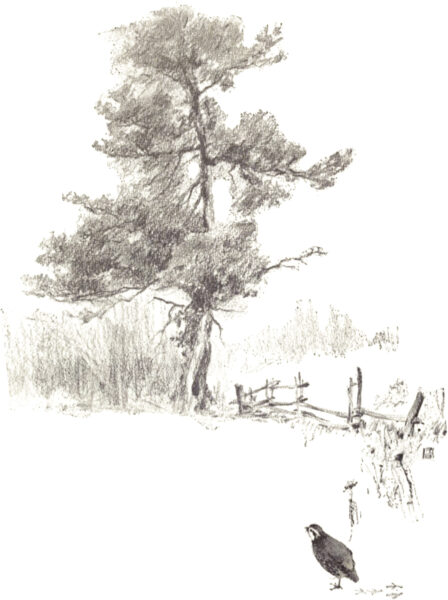
I have not heard the “covey call” of the quail this winter. But there is not a quail left alive in all the fields and sprout-lands within sound of me. I used to hear them here on Mullein Hill; a covey used to roost down the wooded hillside in front of the house; but even they are gone — hunted out of life; shot and eaten off of my small world. What a horribly hungry animal man is!
But you may have the quail still in your fields. If so, then go out toward dusk on a quiet, snowy day, especially if you have heard shooting in the fields that day, and try to hear some one of the covey calling the flock together: Whir-r-rl-ee! Whir-r-rl-ee! Whirl-ee-gee! — the sweetest, softest, tenderest call you will ever hear!
VII
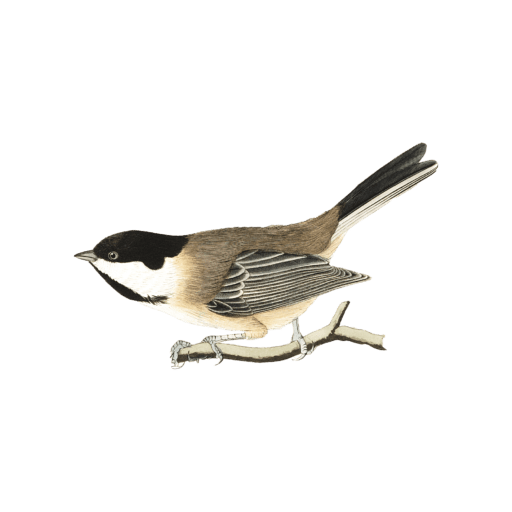
And you certainly do have chickadees in your woods. If so, then go out any time of day, but go on a cold, bleak, blustery day, when everything is a-shiver, and, as Uncle Remus would say, “meet up” with a chickadee. It is worth having a winter, just to meet a chickadee in the empty woods and hear him call — a little pin-point of live sound, an undaunted, unnumbed voice interrupting the thick jargon of the winter to tell you that all this bluster and blow and biting cold can’t get at the heart of a bird that must weigh, all told, with all his winter feathers on, fully — an ounce or two!
VIII
And then the partridge — you must hear him, bursting like a bottled hurricane from the brown leaves at your feet!
IX
Among the sweet winter sounds, that are as good to listen to as the songs of the summer birds, you should hear: the loud joyous cackling of the hens on a sunny January day; the munching of horses at night when the wild winds are whistling about the barn; the quiet hum about the hives, —
“When come the calm mild days, as still such days will come,
To call the squirrel and the bee from out their winter home.”
And then, the sound of the first rain on the shingles — the first February rain after a long frozen period! How it spatters the shingles with spring — spring — spring!
X
It was in the latter end of December, upon a gloomy day that was heavy with the oppression of a coming storm. In the heart of the maple swamp all was still and cold and dead. Suddenly, as out of a tomb, I heard the small, thin cry of a tiny tree-frog. And how small and thin it sounded in the vast silences of that winter swamp! And yet how clear and ringing! A thrill of life tingling out through the numb, nerveless body of the woods that has ever since made a dead day for me impossible.
Have you heard him yet?
XI
“After all,” says some one of our writers, “it is only a matter of which side of the tree you stand on, whether it is summer or winter.” Just so. But, after all, is it not a good thing to stand on the winter side during the winter? to have a winter while we have it, and then have spring? No shivering around on the spring side of the tree for me. I will button up my coat, brace my back against the winter side and shout to the hoary old monarch —
“And there ‘s a hand, my trusty fiere,
And gie ‘s a hand o’ thine ;”
and what a grip he has!
Sign up to receive your printable list of these goals for nature winter study in the form below!