The Best Places to Buy Books for Your Homeschool

Homeschooling, at least the way we do it, involves buying many books! I wrote a few months ago about how I use book lists to find homeschool books to go on our shelves, but how do you build up a good home library without breaking the bank? And how do you find good sources for buying books in the first place?
I initially pondered writing about this topic a while ago, but then I met a fellow homeschool mom who has become a dear friend and also happens to have an extensive home library. When I saw her 3000+ books, I asked her if she would be interested in writing a post about buying books as she obviously has a lot of experience in this area!
I met Julie at the Charlotte Mason Educational Retreat this past February. She and her family had just moved to Colorado, and she was still trying to figure out where to put all of her books in their new, smaller house. Little did I know just how many books that meant. When she invited my kids and me to her house to spend the day with her and her kids, I was in awe (and not a little jealous!) at the library she has amassed over the years.
Among many gems, I particularly admired her beautiful collection of vintage Landmark books, two mint-condition Halliburtons, and one beautiful copy of The Sea Around Us: Young Reader’s Edition (which is pretty much impossible to find for a reasonable price these days). Part of the awe is that I know she is wise in her spending and that she didn’t pay more than a few dollars for any one of these, so I truly admire her book-buying prowess. In this post, Julie is offering her tips for finding books, and I share a few of my own at the end as well!
How to Find Books for Homeschooling
Julie’s Favorites
Would Augustine say I have disordered affections for books?
When we decided to homeschool, and I began researching methodologies and programs, I knew early on that Charlotte Mason would be our guide. The books! Time spent in nature! And “leisurely inactivity” had a real nice ring to it. I had run across AmblesideOnline many years before (God is good and also subversive), and when I went back to the website to look it over, I was hooked. Also a bit intimidated, but once we started, that melted away in the gentle joy of happy days with my children.
I’m just kidding – I had a first grader and a 4-year-old, so there was plenty of chaos and mayhem, but there was also beauty and joy and wonderful stories and rocks, acorns, and seashells all over our house. And roly-polies (MAGNA-TILE houses aren’t roly-poly- or ant-tight, though they will hold very large beetles or cicadas for short periods of time). The beautiful incorporation of art, music, movement, Shakespeare, Bible, languages… and books! Books that I already loved or admired, books that had been on my To Be Read list for years, books that I had heard of but never read! How exciting! So, I set out to gather the books we needed for year 1, with an eye out for titles we didn’t own and would need in the next couple of years. This innocent beginning has turned into what I suppose you would call a home library.
My homeschooling experience is with AmblesideOnline (AO), so that is what I will talk about, but you can apply these same tips to other curricula or booklists. It is a great idea to print out the booklist and also save it to your phone. I like a printed list but found it bulky to carry around and flip through while out and about, so I saved the Master List to my Google Drive so I can access it easily. I saved my own copy of the list and added a page with extra books I am looking for, so it’s all handy. It’s also a good idea to make it accessible offline, in case you end up in a fantastic backwoods bookshop with no internet service.
The Library
When I started looking for books in earnest, the first place I went was our local library, which had several branches. Many (maybe most) public libraries have a Friends of the Library group that sells books that are donated to the library or that have been culled from the shelves. We have lived in several different places, and all of them have had a sell and/or free books section.
I have found some treasures here! The prices at the library can’t be beat; books are often only $1 (especially children’s books, because they want kids to read!), and rarely more than $3. Also, watch for the big fundraising sales that libraries have throughout the year. This is a great way to support the local library and also grow your own collection.
Used Book Stores
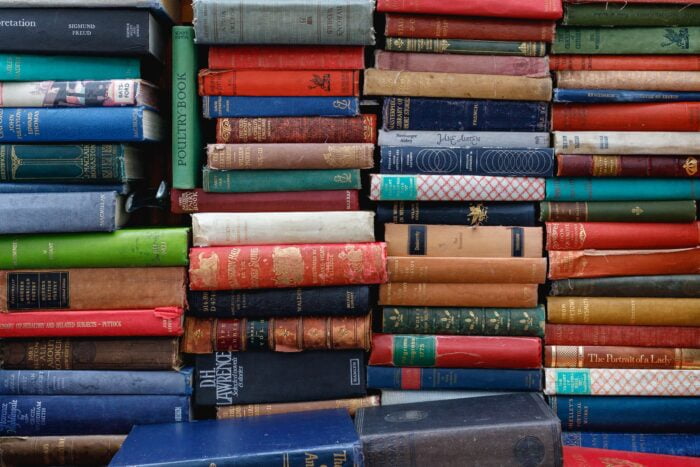
Search Google Maps for used bookstores in your area. We have lived near some gems and also in areas without anything nearby. Prices also vary widely, and some used bookstores are priced too close to new prices for my taste. My favorites in this category are the ones that are like huge caves lined with books, where a stack could fall on you, and you might not be found for years. If you have time to look in places like those, you can find some good ones!
Thrift Stores
Shops like Goodwill, Salvation Army, and the Habitat ReStore usually have a book section. Mileage really varies here, and often, the books are not sorted, but you never know! Some thrift shops become sort of a center for books and get big huge bins that you can dig through. I once found a bunch of Thornton Burgess books at a place like this. You might want to take hand sanitizer. ????
Antique Stores
Antique stores also often have a book section, though it is also super hit-and-miss. Prices can be higher, but not always!
Facebook Marketplace
I met a retired teacher through a Facebook Marketplace listing in the beginning of my book-collecting journey, and she turned out to be such a gem of a lady and a blessing to our family. She was downsizing due to a move and was so happy to meet someone else who valued her books. She gave us a couple hundred titles and still keeps up with us years later. Sometimes, school libraries will post books they have culled, some estate sales have lots of books, and sometimes people are getting rid of books they just used for decoration. Of course, all the normal risks that apply to buying things from strangers on the internet are present.
There are some booksellers on Instagram that post lovely editions of books commonly used by Charlotte Mason homeschoolers. You can search the hashtag #fortheloveofbookssale and find several good sellers. These are generally vintage editions and are priced fairly and not at bargain prices.
Etsy
Etsy is also worth searching when you are looking for a particular book, but it can be more expensive.
Rebecca’s Favorites
Being the introvert and homebody that I am, my preferred method of buying books is on the internet. The advantages are that you generally have a wider selection of great books, and it’s much easier to find any specific titles you’re looking for than if you go to a brick-and-mortar shop or book sale. The disadvantage to this is that you do usually pay for the convenience. Though you can get great deals on used books online, finding them at a brick-and-mortar shop or book sale is generally cheaper.
Bookfinder
If you do find that you are short on time and can’t peruse the shelves at your local booksellers, Bookfinder is a great place for finding the lowest prices on used books. I know many homeschool moms have favorite places for used books, but the beauty of Bookfinder is that it searches “100,000 booksellers worldwide, accessing millions of books in just one simple step.” This includes all of the used book sites we know and love, like Thrift Books, Half Price Books, and Abebooks, as well as eBay, Amazon, Blackwell’s, and many others.
It has a handy feature where you can type in your book’s author and title, and they’ll show you the results for that exact search, as well as similar ones. You can look at the listings for each of those individual results, or you can see them all combined. So, for instance, if a bookseller included the author’s name in the listing title, you can see those listings as well as the ones that just have the book’s title or any other strange combination. If you are looking for a particular edition and know the ISBN, you can also search by that. Or if you don’t know the ISBN but have other details, you can also search by publisher, publish date, first editions, signed copies, binding, etc.
When you are on the listing result pages, the column on the left links to new books, and the column on the right links to used books. The information in the listing includes the condition of the book, additional information about the listing, the price (including shipping costs, though some offer free shipping), and sometimes the publication year. I generally just do a text search on that page for “very good” and see how expensive compared to the new copy those listings are. Sometimes, I’ll go down to “good” condition if the “very good” options are still pretty expensive.
When you click on the price link, it takes you to the website where that book is sold. So, Bookfinder doesn’t actually sell the books. It’s more like a Google for used books.
And that is how I search multiple sites at once for any books I happen to want. I also use Rakuten to get cash back for each of my purchases, as many online used booksellers offer cashback through that as well (so you can buy more books!).
Library Book Sale Room
This piggybacks on what Julie mentioned above about her local library. Our library has a book sale room that offers new titles quite often. One of my favorite memories from our homeschool co-op is visiting this room and finding a beautiful vintage set of the Five Little Peppers series. I sent pictures to the other moms in the co-op, and three of them immediately replied that they wanted them. When I brought them to the desk to buy them, I told the librarian about the pseudo-fight they were having in text about who was getting the books, and she said I had cool friends. I have saved a lot of money on reference books this way, and I appreciate how convenient it is to just stop by that room quickly when I pick up or drop off our checked-out books.
Book Sale Finder
Every once in a while, I’ll search on Book Sale Finder to see what sales are in my area (Julie and I sometimes try and combine book-sale-browsing with a hike). This site lists small ongoing sales at libraries and other used booksellers, as well as larger library book sales that may happen annually or semi-annually and offer tens of thousands of books.
Other Sources
Paperback Swap
Paperback Swap is another great way to find books. When I first began homeschooling, I added all of the books for the grade level of our homeschooling curriculum to my wishlist, and every once in a while, I’d get a notification that one was available and I could have it shipped to me for free.
A disadvantage to Paperback Swap is that in order to get books shipped to you for free, you have to initially ship your discarded books to someone else. Each time you send a book and the person you shipped it to marks it as received, you get a credit, which you can use to order books listed on the site. Of course, you have to wait until the books you want are actually listed on the site, which can sometimes take a while. Still, it doesn’t hurt to have a wishlist set up so you are ready to receive the books when they come in! I’ve used this method to build up a small chunk of our home library with favorite books from my childhood.
Small Businesses
Several small businesses have popped up in recent years that specialize in re-printing classic books. A few of the ones both Julie and I have used include Living Book Press, Purple House Press, Beautiful Feet Books, and Yesterday’s Classics. A few of these sites often run sales, which is a great time to stock up on books for future homeschool years.
Homeschool Curriculum Sale
I don’t have personal experience with these, but I have friends who have gone to these sales and were able to pick up many homeschool materials and curriculum books at great prices. I most often see these listed on Facebook, especially if they’re hosted by individual families or groups of families who have come together for one event.
One more note about deciding which books to buy. Often, when I find a title on a reading list from a well-respected source, I like to get the book from the library (sometimes I have to use interlibrary loan for the more obscure titles) first to see if it’s a good fit or even worth reading for us. Sometimes, I find that just checking it out from the library is enough, and other times, I know it’s one I want to add to our permanent collection.
So here are the ways two homeschooling moms find books for their home libraries! What would you add to this list?

Enter your email address here to get updates and exclusive downloads, including a free Picture Study Aid!
(If the form is not loading for you, you can also sign-up here!)


If you haven’t perused Exodus Books, you’re missing out. Their database is free to use and a great way to find lists of books by curriculum or publisher or series. For example the Julian Messner biographies https://www.exodusbooks.com/julian-messner-shelf-of-biographies/8814/ are great at a level above Landmarks. Educator Classic Library https://www.exodusbooks.com/educator-classic-library/7999/ and Whole Story Series https://www.exodusbooks.com/whole-story/5212/ are out of print (but plentiful) series which have unusual vocabulary and background information annotated into margin. I make sure to order some things from them every year, because their database and reviews are so useful for building your own Charlotte Mason curriculum.
thank you for posting those links! that is one I have not heard of, so I will look into that. 🙂