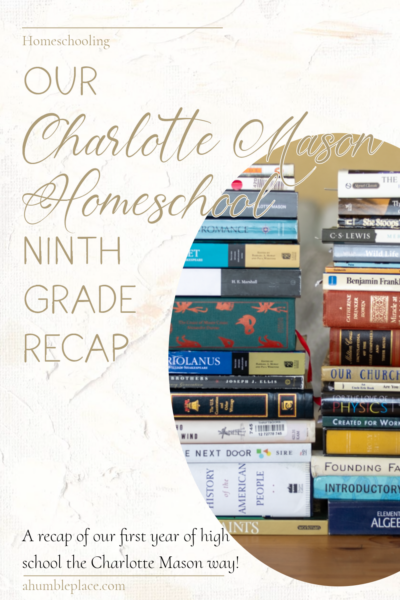
Our Charlotte Mason Homeschool Ninth Grade Recap
(Please note that I have linked to the book lists on the AO website to respect their licensing terms and the hard work they’ve put into such an amazing curriculum that they offer for free. Books that use affiliate links here are not listed on the AO website.)
It is much to be wished that thoughtful mothers would more often keep account of the methods they employ with their children, with some definite note of the success of this or that plan.
CHARLOTTE MASON (HOME EDUCATION)
See our plans for the year from August here.
And so we have finished our first year of high school. Honestly, it wasn’t nearly as scary as I thought it would be, which I hope is an encouragement to others! My only real complaint is how fast it went by, which I think is going to become only more and more of a problem over the next three years. But I know I’ve moaned many times about my kids growing up fast, so I’ll refrain from doing so yet again. (But I am a little sad….)
Anyway…
It was a good year, and I think my plan of starting with AmblesideOnline Year 9 Lite and then adding to it, rather than starting with the detailed Year 9 list and removing from it (which honestly never really happens), worked wonderfully for us. There were some readings that we didn’t get all the way through, and the important ones we’re finishing up over the summer, but that was more because I scheduled too many readings for us to do together. On his own, my son had a just-right amount of work across all the tasks he needed to complete each week.
We did have some growing pains early on – primarily in math (more on that below) – which we had to adjust as the year went on, but nothing that threw us for a complete loop and derailed everything. I feel like the nine years of homeschooling I did before we entered this year have prepared me well for these inevitable hiccups, and it’s nice to have the mental tools I need to tackle them when they pop up.
I was nervous about the once-per-week STEM/Aerospace program he did for the first time this year, and it was a little more work for us to get him there and back every week (or even to some of the farther-away field trips), but it was very worth it. He really enjoyed his time there, learned many new things, had some amazing new experiences (helicopter ride! indoor skydiving!), got some time answering to someone besides me, and thrived. My daughter and I also enjoyed the day for just the two of us, so it worked out really well overall. I have more about what we’ll be doing with that next year in the science section below.
I also did extensive research on high school transcripts and grades. I ultimately decided to use the diploma program offered by our umbrella school, which also gives us official transcripts from a private school. A friend who has graduated two of her kids said that having an “official” transcript when applying to colleges does make things a little easier, so that’s where we are.
And now on to the recap!
Morning Time
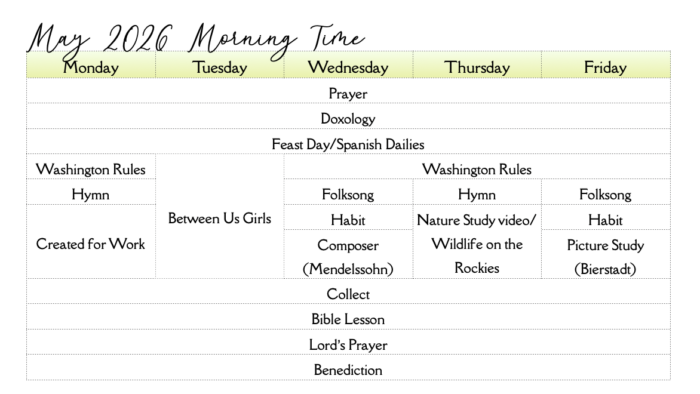
As I mentioned at the beginning of the year, we’ve found a good rhythm with our Morning Time, so it hasn’t changed much in a while, and this year was no different. Because my son was gone every Tuesday, it looked a little different that day when it was just my daughter and me, which was a nice time for us together (I’ll write more about that in her recap post).
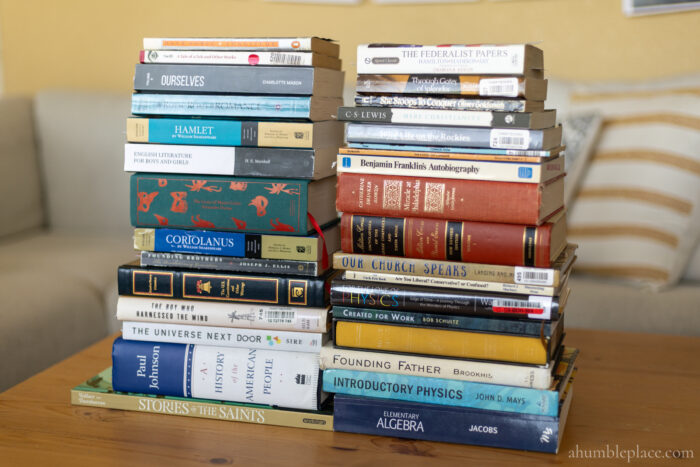
I have a detailed layout of our Morning Time in my planning post. The only change I made was to add a reading from George Washington’s Rules of Civility each morning, as my son was in the American Revolutionary War time period this year. We also dropped Land of Little Rain mid-year and switched to Wild Life on the Rockies by Enos Mills, as it’s specific to Colorado. We didn’t finish it, but we really enjoyed what we read so far, so we’ll continue that next year.
Bible & Spiritual Formation
We did our Bible readings all together, so my daughter joined us for the AO Y9 schedule, which worked out so well. I really enjoy hearing their thoughts and ideas about the passages that we read.
My son and I read Mere Christianity together while watching the CSLewisDoodle YouTube channel, and as this was not his favorite book to read, it was a helpful way to go through it. Lewis brings up quite a few controversial and not-easy topics (I’m looking at you, Book 3, Chapter 5), but we had good conversations about these topics, and I was glad we were talking about them together.
We both liked Through Gates of Splendor, which was a good follow-up to reading Jungle Pilot from Year 8, and I especially appreciated what Elisabeth Eliot wrote in the Epilogue.
History & Biography
As I mentioned in my planning post, we went with Paul Johnson’s History of the American People for our spine, and that worked very well for us. Johnson offers ideas I’ve never considered before, which I appreciated and that sparked good conversations, especially when comparing them to our other readings.
I think my favorite book this year was Miracle at Philadelphia, as it provided such a thorough account of the Constitutional Convention. Admittedly, I knew very little about it before reading this book, and the parallels between it and the other history books we were reading all fit together so well. We also learned later in the year that the Freedom Plane was stopping in Denver, so we were able to see some of the documents that were related to that meeting, which was a fun way to end the year!
B said that his favorite history reading from the year was Lord Chesterfield’s letters, which we did together, and that was another great source of conversation (and some amusement)!
We also read all of the original source documents listed in the Lite schedule. He read Founding Father on his own, and we read Founding Brothers together, which also made for good discussion. We ended up skipping The Story of Napoleon just to lighten the schedule, but I did offer it to him as a free read.
Literature
We mostly stuck to the AO schedule in Literature, except we skipped Gulliver’s Travels (you can read why in the planning post), and I offered Pride and Prejudice and Rasselas to him as free reads. We read all of the books together except The Count of Monte Cristo, only part of which is scheduled over the course of the year because it’s so long. Despite its length, he really liked it and finished reading it on his own, not long after our school year ended.
I had intended for us to do three Shakespeare plays this year (Coriolanus, Hamlet, and The Merchant of Venice), but we only got through Coriolanus and about half of Hamlet (which we’ll finish over the summer). This is the first year that we haven’t finished three plays, and the perfectionist part of me is pretty annoyed, but the I-love-homeschooling side of me is appreciative of the fact that I had the flexibility at the end of Term 2 to say we were going to keep going with Hamlet, and that felt good. We’ll try again for three next year.
Poetry
No changes here! I read the poetry aloud just after Morning Time, then asked what he pictured as I read and what stood out to him. This worked well for us.
Language Arts
Copywork
Switching from a page of copywork every day to just one commonplace entry per week worked well for us. He wasn’t always able to find a quote to put in his book, but it was interesting to see which ones stood out to him when he did.
Dictation
I debated including dictation in the schedule this year, but I decided to keep it in when I saw that it was on the scheduling matrix for his Form, I kept it. I think this will be our last year doing it, though, as his spelling is very good, and I want to lighten the schedule where I can.
Grammar and Composition
We finally finished the second of our two Junior Analytical Grammar books this year, and he then moved into The Art of Composition. I thought we might finish it by the end of the year, but we didn’t, and I’m fine with that, as I wasn’t sure we’d be moving on to the rest of the books in the series anyway.
I required him to do one written narration per day (one written two days after the reading), and the rest narrated orally. Using the lessons in the book, he then edited those written narrations. I appreciate this because Karen Glass goes over specific editing ideas in each lesson, which gets him thinking about how to improve his writing. We’ll continue with this book next year.
Recitation
Here are the pieces he learned for recitation:
Old Testament
Term 1
- Judges 7:1-22
- 1 Samuel 3:1-21
Term 2
- 1 Samuel 15:16-29
- 2 Samuel 22:1-20
Term 3
- 1 Kings 3:1-15
- Ecclesiastes 3:1-15
New Testament
Term 1
- Mark 2:1-22
- Mark 8:27-9:13
Term 2
- Acts 1:1-4
- Acts 5:12-32
Term 3
- Acts 26:12-29
- James 5:7-20
Psalms
Term 1
- Psalm 34
- Psalm 37:1-22
Term 2
- Psalm 119:1-19
- Psalm 119:105-124
Term 3
- Psalm 136
- Psalm 145
Poetry/Shakespeare
Term 1
- Alexander Pope – “An Essay on Man Epistle 2” Lines 1-40
- Alexander Pope – “An Essay on Criticism” Lines 215-252
Term 2
- William Cowper – “The Nightingale and the Glowworm”
- Shakespeare – Hamlet “To Be or Not To Be” Soliloquy
Term 3
- Lord Byron – “Child Harold Canto IV” CLXXVII-CLXXXI
- Lord Byron – “She Walks in Beauty”
Foreign Language
Spanish went really well this year! Both kids met together on Zoom one hour per week with their teacher from The Spanish Institute of Honduras throughout the year and made good progress. Four days per week, we also did one of the lessons from the Repertorio, Cuna in Term 1 (I made my own extremely rough versions in Terms 2 and 3 as she did not release any more this year that were adequate but not ideal – I’m hoping she releases more for next year).
To supplement my son’s Spanish time for high school credit, we also listened to, narrated, alternated reading aloud, and translated several of the stories from Simple Stories in Spanish. This allowed him to work on his comprehension and pronunciation.
Geography
In my planning post, I mentioned that we would read Dava Sobel’s Longitude in Term 1 and then switch to Undaunted Courage in Terms 2 and 3. We did make it through Longitude (which he enjoyed). However, after considering how long Undaunted Courage is and reading through content concerns on the AO forums, I discovered that Richard Halliburton’s Royal Road to Romance used to be scheduled in Year 9, so I used that instead (and he enjoyed that one as well).
Ironically, I was reading Halliburton’s Book of Marvels: Orient concurrently with my daughter in Year 6, so it was fun to compare the readings as many of them lined up. It was pretty neat to feel like we were coming full circle with Halliburton, as my son remembered several of the stories from Book of Marvels.
This was the first year we also did ten minutes of Seterra map drills every week, and both kids really enjoyed that. He made it through the 50 states and Europe, and is now working on Africa.
We also filled out maps along with other subjects; e.g., for his news articles, I printed maps for each continent, and he labeled the places mentioned in the stories.
Scouting
We got through the unit on Observation with our homeschool group, but decided to just stick with our Nature Explorers lessons for the rest of the year.
Citizenship
We read The Universe Next Door together, and it was very challenging for both of us, but we persevered and learned a lot. Later in the year, I was talking to a friend whose daughter is a year ahead of my son in AO, and she mentioned they made a chart with all the answers to the “basic questions” for each worldview, which helped. There’s a chart in the back of the book that does that as well, so I think I may rely on that more if/when I read this with my daughter. It was hard, but thought-provoking.
Plutarch is always so interesting, leads to great discussion, and B says these lessons are his favorite of his citizenship readings. I’m glad he’s a part of our week.
And, of course, Ourselves is a book that everyone should read regardless of their age! We read this one together and, again, it results in great discussion!
Government and Economics
We enjoyed Thomas Paine’s Common Sense (he convinced me!) and the essays on economics. I also added Richard Maybury’s Are You Liberal, Conservative, Confused? from the non-lite booklist, as I feel this is an important topic given our current political tumult. Maybury is very opinionated and is obviously not for everyone, but the beauty of reading books like his and then having my son narrate is that we can talk about these ideas that come up and weigh them against other things we’ve read.
Current Events
You can read the original plan for current events here. I did let my World Teen News subscription lapse in October and tried to just use Decaf, but ended up renewing it because the way we were doing it before worked better for us. I also used a few articles from Newsela Lite throughout the year.
Science
I was nervous about science this year as it was the first year he’d be using a more textbook-like book for a subject (you can read why we did this in the planning post), but it went so, so well! Introductory Physics was written in an instructive, yet conversational way, and the concepts were explained in very understandable language. My son spent a lot of time each week on physics, doing the readings, working through the problems, completing the quizzes, and going through the weekly review guides, but I think it was just the right amount of work for him to understand the ideas as well as prepare him for higher-level science classes.
We also did the five experiments with three other boys in our homeschool group, with one of the moms leading those activities, and though we didn’t often get the results we expected (especially with the truck), they were still able to work through the calculations, see the differences, and discuss why the results were different than their predictions. Overall, I was very pleased with how it went and his progress in physics. Next year we’ll be tackling biology!
I didn’t use as many of the Paul Hewitt videos as I thought I would, but it ended up being fine because the book explains the concepts very well.
He also read For the Love of Physics and part of The Boy Who Harnessed the Wind (we were not able to finish it during the school year, but he plans to finish it on his own over the summer), both of which he enjoyed.
He also completed a local year-long, one-day-per-week STEM/Aerospace program for homeschoolers and really liked that as well. I had planned to continue him in that program over the next three years, but our state congress changed the funding rules for homeschool enrichment programs (and especially for students in umbrella schools, as we are) in May, so this is up in the air, sadly. They are scrambling to ensure they are compliant with the new rules and are also trying to come up with an option for kids in umbrella schools, but very few details have come out, so I’m not sure what it might look like. Hopefully, if that doesn’t work out, we can find an alternative, as I think it was beneficial for him in so many ways.
Nature Study
We did not end up reading any of the books on the book list for our nature study. I did start reading Land of Little Rain during our Morning Time, but as I mentioned above, I later decided to drop it in favor of Enos Mills’ Wild Life on the Rockies, which is about Colorado.
For nature study in the weekly hikes with our homeschool group, we used the Nature Explorers guide from Sabbath Mood Homeschool. During our Morning Time before the hike, we would watch the video for that day’s lesson, and then talk about our goal (or what we were looking for – usually whatever we learned about in the video) just before the hike. Because we were respecting Nicole’s licensing for using the guide in groups, we did not each have a copy, but I think I might buy my own for next year so I can have access to her book lists for each section, as I have always found her book recommendations so helpful.
Both kids also completed weekly entries in their nature journals, usually during our hikes.
Math
You can read about this year’s math drama in the planning post as well. We began the year with Art of Problem Solving (as recommended on the RightStart website for high school) and soldiered on for six weeks before we knew it really wasn’t for us. Jacobs’ Elementary Algebra was another one on the list, and two of my good friends have used it with their students, so I borrowed a copy from one of them, and it was lightyears better. He has thrived in that program and made excellent progress, so it was a very good switch for us. I’m also very happy with how well RightStart prepared him for Algebra!
Logic
As I mentioned in the planning post, we dropped How to Read a Book last year for time constraints. He did read the essay “Love is a Fallacy” at the end of the year and found it amusing.
Art
We continued reading Janson’s The Story of Painting this year, just in Term 2. It’s a good crash course in art history, and I think supplements picture study well.
For art creation, one afternoon every week, both kids spent about 20 minutes going through the instructional videos of the Bloom and Brush Brushdrawing Course, and that worked extremely well for us!
Picture Study
We had a lovely range of artists this year and even made it to the Denver Art Museum in Term 1 to see the Pissarro exhibition, which included two pieces we learned about. I always love seeing the paintings in person, especially after having studied them. There are just certain things that prints can’t recreate, and being able to see brushstrokes in person is a gift.
Music
Composer Study
We enjoyed all of our composers this year, and they offered a great range of musical styles. I used our Milton Cross for Delius and Mendelssohn, and Heather Suemnicht made a very helpful guide for Scott Joplin, which was a fun option for Term 2.
Hymns and Folksongs
Hymns
Folksongs
The favorite folksong this year was definitely “On Ilkla Moor Baht ‘at!”, and “Awake, My Soul, and With the Sun” was a really great song to begin our days. We also sang a few of these with the residents at the assisted living facility we visit once per month, so it helped to include them in our Morning Time.
Health and Physical Education
For our physical education requirements, we continued our weekly hikes (usually at least 2-3 miles) and will attempt another 14er this summer. He also participated in my daughter’s weekly homeschool PE class when he didn’t have his STEM/Aerospace class.
Life and Work Skills
I opted not to schedule anything specific in this area this year, since he built a remote-controlled plane and a drone in his STEM/Aerospace program. However, he has also taken charge of our garden this spring, which fits in this spot nicely. During our group science days, he also worked on stained glass and a leather Bible cover.
Free Reads
I just looked through the list and realized that we didn’t get to any of the free reads for Year 9. We did finish a few from previous years that we had never gotten around to, but apparently never made it to this list. We’ll keep them in mind for the future!

Enter your email address here to get updates and exclusive downloads, including a free Picture Study Aid!
(If the form is not loading for you, you can also sign-up here!)



Hi Rebecca,
Do you have a recap for Ambleside grade 6 and grade 7 ?
I’ve really enjoyed this one of grade 9.
Warmly, Tracy
I do! You can find all of my planning posts here: https://ahumbleplace.com/topics/homeschooling/charlotte-mason/planning-posts/
I always appreciate your plan/recap blog posts! I am knee-deep in planning for Y9 right now. Do you schedule all 36 weeks of AO plus exam weeks? I’m trying to layout our calendar this year and we always seem to take longer than expected.
Yes, I usually plan 12 weeks of “school time” and then an additional week at the end of each term for exams.