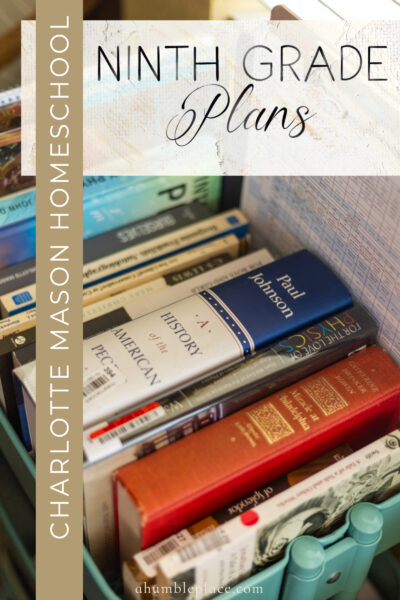
Our Charlotte Mason Homeschool Ninth Grade Plans
(Please note that I have linked to the book lists on the AO website to respect their licensing terms and the hard work they’ve put into such an amazing curriculum that they offer for free. Books that use affiliate links here are not listed on the AO website.)
It is much to be wished that thoughtful mothers would more often keep account of the methods they employ with their children, with some definite note of the success of this or that plan.
CHARLOTTE MASON (HOME EDUCATION)
We have now arrived at high school in our homeschool. I’m still not sure how this happened. I remember so very clearly the morning that we headed down to the basement after breakfast to begin our first day of kindergarten. I had my lesson plans all laid out and the books lined up in my rolling cart next to a newly assembled Ikea table we bought on a whim (which we still use as our school table to this day!) the day before. I remember being very nervous and wondering how all of this was going to go. Could he do it? Could we do it? Could I do it?
And here we are, nine years later, having done it all along. It’s been hard at times, and we’ve had to learn to be flexible and open-minded in terms of how our homeschool looks over the years. But there have been so many good times and victories as well. We have gotten to this point together, and though I said over and over again in the beginning that enrolling him in a “normal” school was always an option hanging out in the back of my mind, I am so glad I never felt like I needed to take that option. I am so thankful for the time I have had with him and the time he has been allowed to grow and learn in his own way. I am so thankful for homeschooling.
So with all that said, we dive into our plans for his first year of high school! My pondering and planning for this year really began last summer, before his eighth-grade year, which was a good way to do it, as I was able to contemplate various aspects of this year for quite a while before I had to actually begin the planning process.
One of the main changes between this year and previous ones is that I chose to use the Lite schedule for AmblesideOnline Year 9 instead of the detailed schedule. This was mainly because last year was a LOT for both of us. It was, in hindsight, probably too much, and I didn’t want to repeat that. I know the detailed lists are meant to be personalized, and the intention is that not all of the books are read, but I struggled to determine what to cut out in the beginning. So this year, instead of starting with the detailed list and cutting out, I decided to start with the Lite list and add. In the end, I think I only added one or two books and actually removed a few books from the Lite list, so this truly will be a lighter load for us. And I feel good about that. Nancy Kelly is known for saying, “Keep cutting back until there is peace in your home,” and I feel like that’s what I did this summer. I cut back things that just haven’t been working for us, and so far, one week into this year, it has made a huge difference.
This year will also look a little different in that he will be gone one full day every week at a local homeschool STEM program (more on this in the Science section below), both kids will be taking part in online live Spanish lessons every week, and my daughter will be in a weekly homeschool PE class. We will also be continuing weekly hikes with our homeschool group (along with a monthly visit to an assisted living facility with them). All of these things together mean there is less time at home for all of us, but especially him, so I wanted to make a reasonable schedule for him.
On the topic of the schedule, I also decided to overhaul ours. Instead of trying to cram two readings in for myself each day, I reduced that to one and gave the kids a few more readings to do on their own. I really paid attention to the scheduling matrix that Nicole Williams made based on the PUS schedules, and laid out our days thoroughly, even down to being done with certain things by certain times, and making sure all of us have enough time for the subjects we need to get through. Admittedly, I have been in the habit of being more haphazard about this up to this point, which is leftover from when my kids were young and we had plenty of time to get everything done in the morning. But as they’ve gotten older and their weekly tasks have increased, that has become more challenging.
Because we now have various things going on during different days of the week, and because he now has more school-related tasks in the afternoon, I also ended up revising our overall family schedule, and it’s been good to revisit that and refresh my mind on our family rule and what is most important to us. I am excited to see what this year brings for all of us!
And now on to the planning for Year 9!
Morning Time
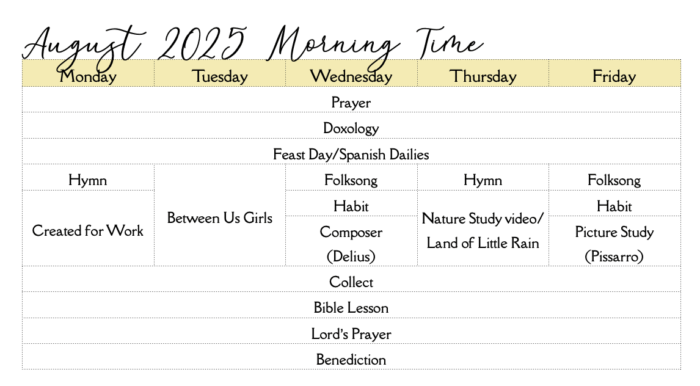
Our Morning Time this year is going to look very similar to how it has in the past several years, other than a few minor changes. We’ll begin with prayer, then move into singing the doxology. If the day falls on a feast day, we’ll read about that saint. We’ve gone through the majority of Stories of the Saints, so I picked up a copy of Our Church Speaks over the summer, which includes more short biographies of individuals from church history. If it is not a feast day, we’ll do our daily Spanish recitations of the date and the weather.
This is followed by alternating our hymn and folksong during which we sing along with Hannah on the folksandhymns channel on YouTube. After this, on Mondays, I’ll read aloud from Created for Work. Originally, this was a book I was only going to read with my son, but I read several reviews that it was good for girls as well, so we’re reading it together! On Tuesdays, when my son is gone, my daughter and I will read a section of Between Us Girls together (I’ll write more about that in her planning post).
After our singing on Wednesdays and Fridays, I have time for our habit scheduled, which means we’ll be reading from Laying Down the Rails for Children. I’ve had that and the original Laying Down the Rails for years, and have tried to implement them off and on since my oldest was in kindergarten, but they always fell to the side when things got busy. I also am a little torn on their effectiveness, or if they’re even needed. I went back and forth quite a bit this year, wondering whether to include this in our time or find another way to work on habit formation. Ultimately, I decided to include it as I feel like I need help in this area, and I appreciate the focus on specific habits that the guides provide.
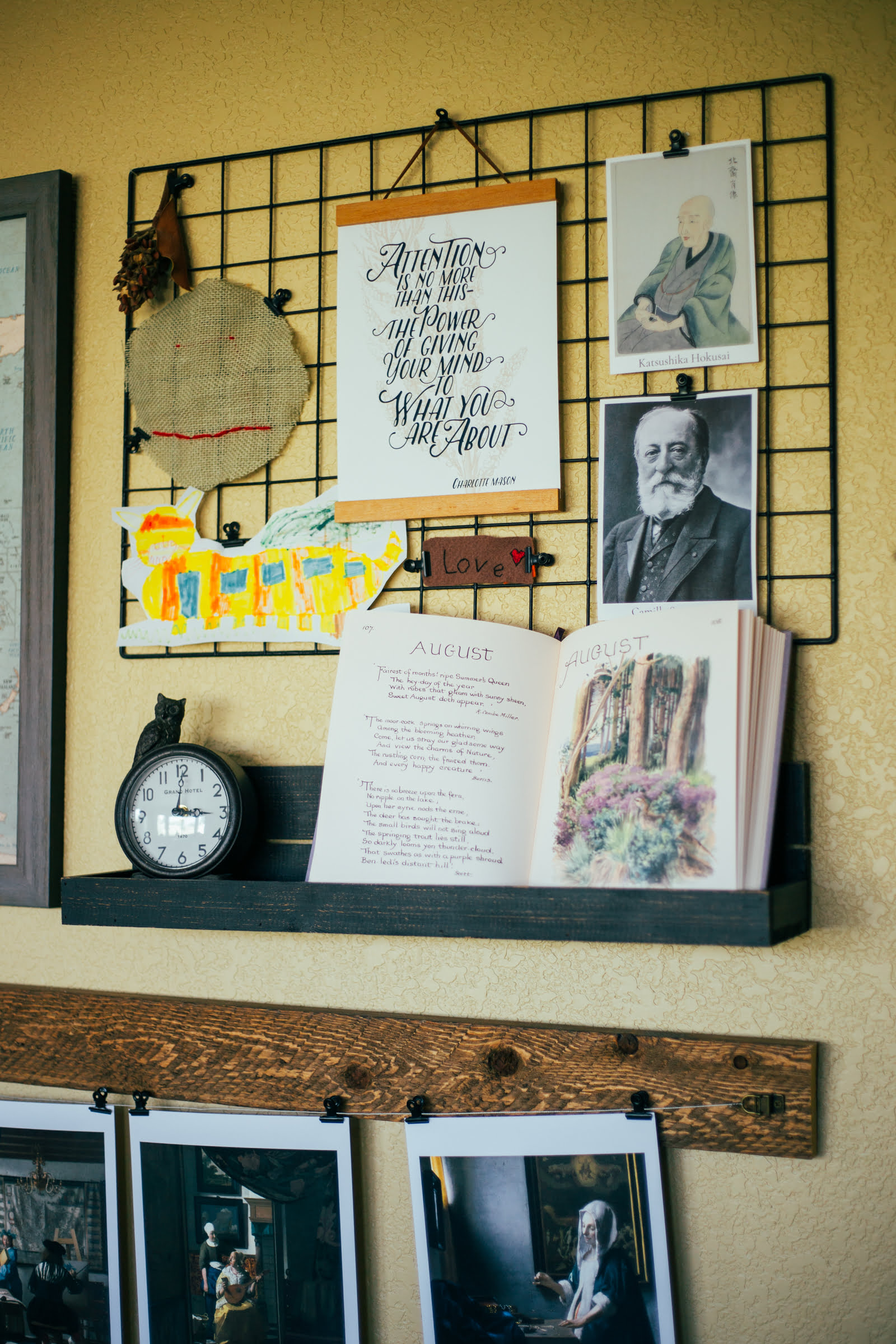
After our habit reading, on Wednesdays we’ll move into composer study, and on Fridays we’ll move into picture study (more on those two things below).
On Thursdays, after our singing, if we have a nature study video to watch to prepare for that day’s hike (more on that below), we’ll watch that and then read from Land of Little Rain together, which is scheduled as a nature study reading for Year 9. We read the Year 8 nature study book (Rural Hours by Susan Fenimore Cooper) together during Morning Time last year, and it worked well for us, so I thought I’d continue that practice this year.
During the entire week, after these things are done, we’ll pray our weekly collect. This is the prayer written for the particular week we’re in from the Book of Common Prayer. If it’s a holy day or feast day, we’ll read those prayers instead. This will be followed by our Bible lesson (more on that below), then the Lord’s Prayer, and we’ll end with a benediction.
I’ve already made a few changes to this layout, so it may change more throughout the year. If so, I’ll share and changes in my year-end post!
Bible & Spiritual Formation
We’ll be doing our Bible readings all together again this year. I combined both kids into one reading two years ago, and that works better for our time management. They also have their own personal quiet time in the morning (B will be reading My Utmost for His Highest by Oswald Chambers), so these readings are more in a “lesson” format where we read the passage, narrate, and look up any pertinent facts in my commentaries or locations in our Bible atlas. I’ve really enjoyed doing this with all of us together as I find it very encouraging to hear their insights about the passages we read.
History & Biography
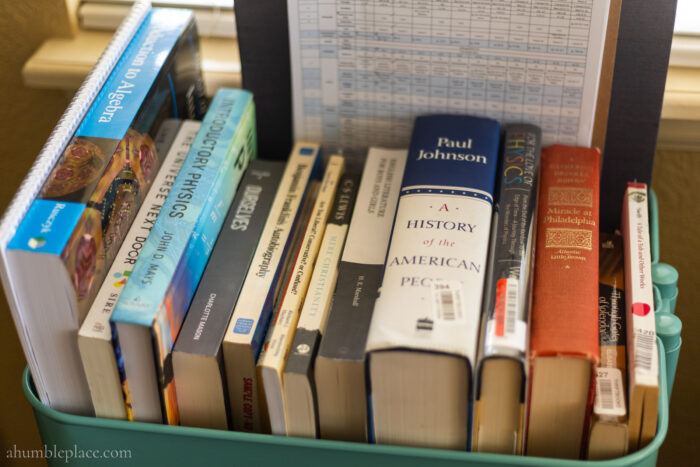
AO offers several different options for history spine books in Year 9, so I looked into all of the titles, not just those on the Lite schedule. We didn’t use the Churchill book in Years 7 and 8 and went with Arnold-Forster instead, which worked very well for us. That, along with the AO history notes about skipping the Churchill book for the American Revolution time period, ruled it out for me. I looked through the other options, either online or from the library, spoke with friends who either have kids the same age or have kids who have done Year 9, and ultimately decided on Paul Johnson’s A History of the American People as our spine. We’ll also be reading all of the original historical documents and speeches, as well as the books in the Lite schedule.
We’ll read the biography section as scheduled. I picked up the H.E. Marshall Napoleon biography and did find it to be probably more appropriate for a younger audience, but since I’m trying to keep this year simple, we’re going with it.
Literature
We’re also going with the literature selections as scheduled, with the exception of Gulliver’s Travels, which I decided to skip. I read it a few years ago and enjoyed it, but even as an adult, I found parts of it challenging to understand, and I suspect the same would be true for my 15-year-old son. I am also not entirely comfortable with all of the content, and since I was looking for a lighter load for him this year, I had no qualms about taking it out. Maybe he’ll choose to do as I did and read it when he’s 37!
Poetry
We’ll also be following the poetry selections as scheduled. I’m especially looking forward to diving into the poetry of Alexander Pope and Phillis Wheatley with him.
We finished The Roar on the Other Side last year, so he won’t be doing that this year.
Language Arts
Copywork
For the first time since 2016, he will not be doing copywork! Instead, I decided to have him do at least one commonplace entry per week, so I got a beautiful Moleskine journal for him just for this purpose. I’m hoping he does more than just one and that this becomes a lifelong habit. However, he has not had much enthusiasm in the past to pick his own copywork passages, so I’m interested to see what he picks when he’s required to!
Dictation
We’ll continue with one dictation/spelling session per week. I thought about dropping this, but it is listed in the scheduling matrix for his Form, so I’m keeping it in the schedule for now.
Grammar and Composition
We didn’t end up finishing his mechanics book last year, but we don’t have much left, so we’ll go through the rest of that this year before he switches to The Art of Composition. I don’t know that I’ll have him go through all of these books after they’re released, but a friend let me borrow her copy of the first one to look through (and I listened to Karen Glass’s interview with Cindy Rollins about this book) and I think the exercises in that one at least will be good for his editing and writing skills.
Recitation
I do look at the AO recommendations for recitation each year, but usually don’t use them. I had every intention of picking out all of his recitation pieces before the start of the school year, and, as is the case every year, it just didn’t happen. However, I have them picked out for the first term.
Term 1 Recitation Pieces
Old Testament
New Testament
Psalm
Poetry
Alexander Pope
I’ll share the rest in my year-end recap!
Foreign Language
We are taking a big leap in our foreign language education this year and beginning online, live Spanish lessons. The books and resources we’ve used up to this point, especially the Folklore en la cabaña guides from Under the Manzano, have worked so well for us. But we’ve gone through all the ones that are available, and with B now in high school and needing credit hours, I wanted something that offered more instruction than my limited Spanish knowledge can provide. Several friends have been using Puentes from the Spanish Institute of Honduras in their own homeschools, so we are now scheduled to meet with our Spanish instructor for one hour each week.
On a daily basis, we will go over the date and weather in Spanish during Morning Time. Later, we’ll also go through a Repertorio from Under the Manzano and learning a Spanish folksong, hymn, poem, and Bible verse. I love the layout of these as they’re essentially open-and-go, which means I don’t have to prep anything, and that is a wonderful thing.
I also debated picking up Latin again, but ultimately decided to go with my plan of keeping things simple and won’t be including it this year.
Geography
He will be reading Longitude in Term 1 as scheduled, but since that is the only book scheduled for geography, and I picked Undaunted Courage up at a library book sale several years ago, I’m adding that in Terms 2 and 3 also.
For map drills, I’m going to do what I’ve seen suggested many times on the AO forums and what some of my friends do and use the Seterra map quizzes to focus on the specific areas we’re learning about. For him, I’m starting with the 13 original colonies, and then we’ll move on to other maps based on whatever he’s studying when he learns that map. I’ve never done it this way before, but map drills are something I’ve struggled to actually make happen, so we’re going to give this a try.
We’ll also be filling out maps as we go through the other books we’re reading. I’ve printed a few blank maps from Seterra for his binder, and we’ll use the “Map by Map” books to fill those out.
Update: I read more about Undaunted Courage on the AO forums, and between the length of the book and some of the content, I decided to skip that one. Instead, I went with another book that is recommended frequently on the AO Forums for Year 9: Richard Halliburton’s Royal Road to Romance. He’ll read this in terms 2 and 3.
Scouting
Under geography, I’ll also be leading scouting lessons from Scouting for Wild Ones with our homeschool group once per month. We’re beginning with the section on Observation, and I’ll share the other sections we cover in my year-end recap post.
Citizenship
We’ll be following the AO Plutarch schedule as written this year. Anne White’s guides make it so incredibly easy, and I love that this is a subject that we all do together. It has become a highlight of the week for me.
Government and Economics
No changes for us here either. They have a “basic government book” listed, but we are going to wait to do that in a later year.
Current Events
This is one of the subjects that both kids are the most excited about. A friend told us about The World from A-to-Z last school year, so we added it into our lesson time at the end of each day, and we are all hooked. It’s a great way for all of us to stay informed about current events and discuss what’s happening in the world together.
I also subscribed to World Teen News last year and printed out two articles per week for him to narrate (it also comes with a bi-monthly print magazine that he likes). That will end in October, and at that point, I’m thinking about switching to Decaf, which is a weekly article put out by The Pourover (the news source I use for myself) for families. With this plan, I’m going to ask him to narrate the article he reads, but also narrate one of the news stories he’ll see on The World from A-to-Z.
Science
As has been the case since Year 4, science is the area where we stray the most from AO, and we will not be using Apologia, BJU, or Signs and Seasons (which we haven’t used in any of the previous years either). When I began thinking about the high school years for him, I turned to my wonderful friend Dawn Rhymer, who graduated from and taught physics at the United States Air Force Academy, and has graduated two of her own kids. Among a few different options, one of the curricula she recommended was Novare. While these are considered textbooks, they don’t read like the textbooks I used in school, and Novare has made improvements on the traditional textbook model. My chemical engineer-husband and I both also appreciate their approach to teaching science in general. This is not necessarily a recommendation for these books, as I’m honestly not sure how they will work for us, but I did want to share why I chose Novare in the first place.
I also read a few posts on the AO forums about science in the high school years, specifically, and in some cases, students who graduated from high school who hadn’t used a textbook felt unprepared for their college courses. This isn’t to say that I think all high school students should use textbooks no matter what, but it was something I kept in mind when considering our science path, especially as I am fairly certain my son will be pursuing a career in electrical engineering. Some AO educators have used a mixture of textbooks along with living books that are supplemental to the main science spine, and I feel that’s going to be a good path for us. If Novare works well, we’ll continue with their recommended grade-level pathway but also include some of the AO science and nature study books as well as options from the Sabbath Mood Homeschool living science book lists (especially biographies!). This year, to supplement his physics study, we’ll also be reading For the Love of Physics, and I’ll be adding The Boy Who Harnessed the Wind (I haven’t yet decided if I will give him the young readers edition or the regular version for content considerations) as a free read.
When I purchased the Introduction to Physics program, it came with several digital resources, including a lesson plan, guides for parents, “weekly” review guides for students (they don’t actually happen every week, but that’s what they’re called), quizzes, and exams. The book also includes chapter exercises that he will be doing as well. The lesson schedule and guides are very comprehensive, so I’m using these to lay out our year, but we’ll be taking it week-by-week to see what works for him and what doesn’t. I’ll also use the Paul Hewitt lab videos and he’ll watch these with the topics covered in the book.
The beginning of the book includes a section on setting up a solid study strategy, which I think offers some good suggestions of habits for him to get into for any subject. There is an additional book scheduled that thoroughly teaches him how to do a lab report as well.
For lab work, we will be doing all of the experiments with our homeschool group, as one of the other families will also be using the Introductory Physics book with their Year 9 son, and two other high school boys will be joining just for the experiments. I am looking forward to doing experiments in community!
Science includes another significant change this year in that he’ll be spending an entire day every week out of the house at a local STEM/aerospace program designed for homeschoolers. It’s a program I’ve been considering for a few years now as we have a few friends who have had their kids go through it as well. It includes flying in various aircraft, talks by speakers in the aerospace field, field trips to local aerospace attractions, and workshops. He’s not particularly interested in the aviation part, but as he enjoys programming and building electronic things, the remote control airplane- and drone-building component interests him very much. This is the last year that he is eligible, because of his age, to attend the Introduction to Aerospace class, and another friend from our homeschool group also enrolled her son in that, so I stepped w-a-y out of my comfort zone and enrolled him. This way, also, if he decides he wants to continue in their drone program (which includes at least two more years of classes), he has that option. I read a few years ago a post from a fellow homeschooling mom with older children that she specifically looked for activities like this for her high school-aged boys to be away from home part of the week and “out from mom’s apron strings” because she felt like it was good for their development. It has stayed in the back of my mind ever since, and while I don’t know that I fully agree, I am very interested to see how all of this goes.
Nature Study
From the AO book selections under this topic, we will be skipping all of them except Land of Little Rain, which I will include in our Morning Time rotation (see above). Since he will be studying physics this year, I might save Microbe Hunters for when he is studying biology. We also already read the young readers edition of Sea Around Us in Year 6, so I didn’t feel the need to include the “grown-up” version again this year. And as I mentioned above, I’m adding The Boy Who Harnessed the Wind as a free read biography, so I decided to drop Great Astronomers as well.
We’ll be doing nature study with our homeschool group during our weekly hikes using the Sabbath Mood Homeschool Nature Explorers guides this year, so we will not be following the AO nature study rotation. I am really looking forward to using these guides as they look so thorough and well-done!
We’ll also be using the Bloom and Brush nature journaling prompts along with the brushdrawing component of the course (more on that in the “Art” section below) to make entries in our nature journals every week.
Math
He finished RightStart Level H, which covered pre-Algebra, over the summer, and we are now diving into the world of Algebra. We have been doing RightStart since he was in first grade, so I’m interested to see how he does with a different math program. Both curricula have a conceptual approach, but RightStart, especially in the last two years, was very heavy on teaching concepts through geometry, which was sometimes challenging.
AoPS is a little more traditional in how they teach math; however, because they focus on “problem solving,” they sometimes include problems in the exercises that he can solve using what he has already learned, but hasn’t necessarily learned how to solve. He is very much a problem solver, so I’m hoping this is a good fit for him.
I’m not positive we’ll be using the videos or Alcumus, but if he does run into any problem areas, I will be tapping into these resources as well.
Update: AoPS was good in some ways as it challenged him to think about the problems differently, but he found that approach frustrating at times, as well as the fact that the book moved too quickly through concepts, and it was evident that it was going to take entirely too long to get through it. I ended up switching him to Jacobs’ Elementary Algebra, which also has a conceptual approach, in October, and it has been an excellent choice for us!
Logic
We ended up dropping How to Read a Book last year because I needed to cut something, and I don’t think we’ll be continuing it unless he is interested when he’s older. He will be reading Love is a Fallacy.
Art
He’ll continue reading The Story of Painting throughout the year. In the last term of last year, I had him read just a few pages every week instead of scheduling whole sections every few weeks, and it seemed to stick with him better, so I’ll be doing that this year as well.
For art creation, we’ll be using the Bloom and Brush brushdrawing videos and pairing what we learn from that with our nature journaling entries (see above in the “Nature Study” section). I did brushdrawing with him for a year or two when he was younger, but my daughter wasn’t old enough to participate, so I’m looking forward to doing it again with them both in a much more guided manner through Joy’s videos.
Once we’ve finished the Bloom and Brush course, we’ll go back to the videos we have left in the Lily and Thistle course.
Picture Study
The Denver Art Museum is hosting a Camille Pissarro exhibition beginning in October, so the timing of his being scheduled for the AO Artist rotation this fall was perfect. We’ll be studying him in Term 1 and then going to see that. I’m tentatively scheduling Angelica Kauffman for Term 2 as she was a contemporary of Jean-Honoré Fragonard, who is on the AO schedule for Term 2. I’m not a huge fan of Rococo, and we’ve already covered it in the past, so I’d rather not do it again. In Term 3, we’ll explore epic landscapes with Albert Bierstadt!
Music
Composer Study
We’ll be following the AO schedule in Terms 1 and 3, but since we’ve already done Mozart, I looked through the composer study guides available from Tillberry Table and chose Scott Joplin as a replacement. She doesn’t currently offer guides for Delius or Mendelssohn, so I’ll most likely just read from the Milton Cross book to learn more about them. I know nothing about any of these composers, so I’m excited for us to explore their music more!
Hymns and Folksongs
Hymns
Folksongs
We got into the habit of singing two hymns and folksongs per term instead of a new one each month (with the AO schedule) when we were in our homeschool co-op, so we’ll continue that practice this year as well. Along with a few other families in our homeschool group, we’ll be visiting a local assisted living facility together monthly to do a type of “Morning Time” with the residents. We decided that it would be easier if we coordinated our hymns and folksongs and sing them together during those visits, so one of the moms came up with this schedule based loosely on the AO schedule. I might throw a different folksong in during the month of December for Christmas, but otherwise we’ll follow this one as written.
Health and Physical Education
We won’t be doing anything specific in the health and physical education area this year other than continuing our weekly hikes. He will need one PE credit and a half health credit in order to graduate, but I plan to use a curriculum for at least the health part of that in a later year.
Life and Work Skills
I mentioned in a different post that I started using the Cook Once, Eat All Week cookbook to batch cook a few meals once per week so we have something fast for busy days. This will come in especially handy this year as we take on more activities out of the house. I did this batch cook day a few times by myself, but then decided that I wanted help, so both kids will be helping me in the kitchen every Monday with the batch cooking. I count this as a life skill!
I was going to schedule some kind of handicraft for him, but decided that with the extra activities he’ll be doing through the one-day-per-week class, he’ll be building and making enough, so we’re leaving it at this for this year.
Free Reads
There are quite a few titles on this list that I’ve never heard of, let alone read. Of the ones I have read, there are a few that I don’t necessarily feel comfortable handing off to him (The Good Earth in particular). If I have time, I will try to pre-read at least a few of these to see if I feel they would be a good fit for him. Otherwise, there are many books on the free reads lists from previous years that we never got to, as well as those recommended in the books listed above that he can read in his free time.
So these are my plans for Year 9 and our first year of high school! As always, I’ll follow up at the end of the year with a recap post sharing what works and what doesn’t!

Enter your email address here to get updates and exclusive downloads, including a free Picture Study Aid!
(If the form is not loading for you, you can also sign-up here!)


Thank you for linking that content warning for Gulliver’s Travels. It’s being assigned to my son and I had no idea about that content!
This is so great to see AO in detail. THANK YOU!
Thank you for sharing. My 6th grader is getting ready to finish Level F in Right Start and I am trying to decide between G or switching to Saxon for 7th grade. How did you like G & H for Right Start? Do you feel that it equipped your child to begin higher level math? You are the only person I know that continues to use Right Start!
G & H worked very well for my son (my daughter just started G) and I have no regrets having used it! While Art of Problem Solving, which was the math curriculum we tried for a few weeks after finishing RightStart, didn’t work well for us, after we switched to Jacobs Algebra, it has been a great fit for us and I feel that RightStart prepared him very well for it. Of course, every child is different, but that has been our experience!
Thank you, this is very helpful. I will keep AoPS and Jacob’s in mind after we finish Right Start.