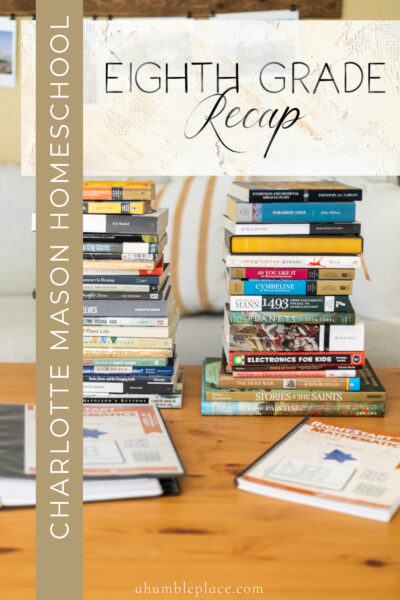
Our Charlotte Mason Homeschool Eighth Grade Recap
(Please note that I have linked to the book lists on the Ambleside Online website to respect their licensing terms and the hard work they’ve put into such an amazing curriculum that they offer for free. Books that use affiliate links here are not listed on the AO website.)
It is much to be wished that thoughtful mothers would more often keep account of the methods they employ with their children, with some definite note of the success of this or that plan.
CHARLOTTE MASON (HOME EDUCATION)
With the end of this school year, my son’s pre-high school educational journey is done. That is both terrifying and amazing (and also sad), as I vividly remember when we started this journey with a new Ikea table and a rolling cart of books in our basement almost nine years ago. How in the world have nine years gone by since that day we officially entered the homeschooling world? It was a blink. I know any veteran homeschooling moms who might possibly be reading this will think my little nine is nothing compared to their 30+, but nine is a lot for me. Nine is a fifth of my life. That’s a long time. But also so short.
I wrote in my planning post that my planning for this year looked quite a bit different than years past, and I am thankful for that. It was a challenging year in many ways, but I think the only reason we (mostly) got through it all was because of the lists, action items, and purchased supplies I made or bought last summer. I am now addicted to making lists on my phone for pretty much everything under the sun, especially random “good ideas for school” that I think I’ll remember forever and always, but then, without fail, fall out of my brain at the next shiny object. I want to offer this advice to all of my fellow homeschoolers, especially the newer ones: get in the habit of making lists of anything and everything you can think of. Our brains have to manage and juggle so many different things on a day-to-day, and I’d even venture an hour-to-hour basis, that lists are our friends. I have quickly become acquainted with them, and it’s a beautiful relationship.
I also started the year with the grand plan of pre-reading, taking notes, and highlighting people, dates, and places for each reading, and using those notes to have good discussions with both kids when they narrated, as well as further my own education! I did manage to keep this up until about March or April, and the discussions were good, and I did further my own education. But then I got sick for a few days and I couldn’t maintain my daily reading schedule (which was also exhausting), and it was all downhill from there. I did manage to continue to pre-read for my son, but all the beautiful notes I had taken up to that point, complete with highlighting and special symbols to indicate those people, dates, and places, came to an abrupt stop. I still have them. They are still beautiful. But they are incomplete, and my type-A side says none of the good stuff matters because I didn’t finish them. My non-Type-A side says that it’s okay, and I did my best, and taking pretty notes is not something I have the capacity to do right now. I am choosing to listen to the latter voice.
So it was a good year in some ways and not such a good year in other ways. I learned a lot about pruning books from our schedule, and also to be okay with that (not being able to check all the boxes is a hard thing for me). I became acquainted with lists (see above). We made amazing new friends in our weekly hiking group. We said goodbye to very dear friends. We found a new news program to watch together, which has prompted good discussion. We fell behind. We read great ideas together. We grew in personal responsibility. We didn’t do great in some of our exams. We discovered new interests.
But the best part of all of this is that we did these things together. The good and the bad. The learning and growing. The loving and arguing. All of it was together. And I’m so thankful we homeschool.
Morning Time
Stories of the Saints
Saints and Heroes
Imaginative Prayer
Connoisseur Kids
Laying Down the Rails and Laying Down the Rails for Children
Our Morning Time routine looked pretty much the same as it has for several years:

This is the printed schedule I have in my planner to keep myself oriented. We began with prayer, then sang the Doxology, then recited the date and the day’s weather in Spanish. Depending on whether or not the day was a Feast day, we either read about the saint who is remembered on that day in Stories of the Saints or Saints and Heroes, or, because we were working on manners this year, we read a section of Connoisseur Kids. Then we sang either our hymn or folksong, alternating days for that, followed by a special topic for each day of the week. I liked to start the week with a reading from Imaginative Prayer so that we could use some of the practices suggested in the book throughout the week (we weren’t great at this, but it was good to have it as an option). On Tuesdays we did composer study, Rural Hours (there were more than enough entries to read this once every week) on Wednesdays, Picture Study on Thursdays, and then the Fridays we were at home we did a habit reading from Laying Down the Rails for Children.
Not every week had all of these boxes checked off, but the rhythm is always the same, which we all appreciate.
Bible & Spiritual Formation
Bible Reading Schedule & Spiritual Formation Book List Here
SPCK Bible Atlas
Bible Resources
As I mentioned in my planning post, I decided to combine both kids into one Bible reading mid-way through last school year, so we still had some catching up to do this year. We finished the Year 7 readings earlier in the year, and then read through the Year 8 readings this year, so we’re all caught up. I really enjoy doing Bible lessons with both kids, as it not only saves time but is also interesting to hear their different thoughts on the same passage. I’m not sure I’ll keep doing this next year, as I may give B his own readings with a commentary, but I’m glad we did it for a little while together.
He read the spiritual formation books on his own. Though I liked it at first, we ended up dropping The Pursuit of Holiness. While I appreciated his message, there were parts I didn’t necessarily agree with, and because B’s workload already felt full, I decided it would be better to drop it. Otherwise, we read the other books as scheduled. He did struggle with understanding all of The Screwtape Letters, and that, along with the fact that mature topics come up quite often in the book, made me glad that we read it together.
History & Biography
History & Biography Book List Here
Year 8 Historical Documents Printable (you will need to join the Cheat Sheet group on Groups.io to access the file)
Book of Centuries
Our historical time period was from 1400 to 1688. The only change I made to our history readings was continuing H. O. Arnold-Forster’s A History of England instead of the Churchill book that’s listed as the main text on AO. The life of Sir Thomas More was fascinating, and we both enjoyed learning about him through A Man for All Seasons and the various history books we read that included information about him.
Sir Francis Bacon was also interesting to learn more about, especially after reading his essays for our citizenship study. Ironically, it seems as though his life did not reflect the wise advice he gave. On the flipside, John Donne did lead quite a virtuous life (though he did make a few bad decisions here and there), and he was also fascinating to learn about.
We both appreciated The Voyage of the Armada (which was the only history book he read on his own) as well. Me, because I have never read the account from the Spanish side (what a mess!), and B, because it’s just an interesting story.
Between all of these different events and the somewhat dysfunctional monarchs (Henry VIII and Charles I in particular), it was an interesting year in history! I kept a running family tree on our whiteboard as I read through Arnold-Forster, so we could keep track of who had who and how they made their way to the throne of England, which was helpful. We’re still finishing A Coffin for King Charles (I managed to find a copy at our local free library!), but it’s also a compelling story and it’s been fun to think back on when we read Children of the New Forest in Year 3 and see how the events leading up to the king’s death tied into that story.
Literature
We ended up skipping both Westward Ho! and I Promessi Sposi, mainly because, again, there was already a lot to read. B was feeling pretty overwhelmed with all the readings, some of which were very long (more about that in geography), at the beginning of the year. So, I dropped a few books as the year progressed, and those two didn’t make the cut. I feel okay about this because both books received mixed reviews on the AO forums, so I don’t feel that we missed much by omitting them.
We read all of the rest of the books together. The History of English Literature for Boys and Girls continues to be a fantastic part of our lessons. It has explained a lot about how different types of literature have evolved, as well as offering brief biographies for the people we’re reading about in other subjects. We will be continuing that in Year 9.
We read all of Everyman, which was short and sometimes challenging to understand, but also interesting, and we’ll be finishing the rest of The Holy War through the audiobook version this summer.
Shakespeare
Shakespeare Schedule Here (we read The Taming of the Shrew in Term 3 instead)
We continued the practice we adopted a few years ago of listening to the Arkangel recording of the play while each of us has our own copy to follow along with, which we all really enjoy. We followed the AO schedule for Terms 1 and 2, but for Term 3, we read The Taming of the Shrew instead. Our weekly hiking group decided to have a year-end celebration together during which the kids would perform a scene from the play, so we all did the same one. It was a lot of fun!
Poetry
I read all of the poetry with him. Fierce Wars and Faithful Loves (from The Fairie Queene) was strange and fascinating, and I enjoyed the commentary that was included in the book, though I didn’t always share it with B. I was glad we read this one together as there was some mature content.
None of the other poetry seemed to resonate with him very deeply, but I was glad he got exposure to these different poets, and especially Shakespeare’s sonnets. It was also interesting to learn more about how George Herbert incorporated shapes into the lines of his poetry to illustrate what he was writing about. These are little seeds being planted that I hope will bloom later in his life, if not now.
Language Arts
Copywork
He did copywork for ten minutes per day as he has done for the last several years. He still hasn’t had much interest in picking his own copywork selections, so he continued writing his repetition selections, but when he finished those, he began writing out Ourselves, which isn’t a bad thing to copy!
Grammar and Composition
Grammar and Composition Book List and Recommendations Here
Junior Analytical Grammar and Mechanics (JAG)
Grammar Resources
We didn’t make it through the Mechanics book because we didn’t always get to grammar every week, but he did make progress, and his overall comprehension of grammar and mechanics is very good. I’ve been very pleased with the JAG books, though the ones we have used are now out of print and I don’t know how they compare to the new ones.
Recitation
Ruminating on Recitation Article (read this first!)
Recitation Guidelines and Student Log (updated in 2021)
Recitation Resources
AO Recitation Recommendations for Year 8
Our repetition/recitation practice continued as it has for several years, and he ended up reciting Herbert’s “The Pulley” at our year-end celebration.
Foreign Language (Spanish)
Under the Manzano
Simple Spanish Year 1 (or new version)
Our Spanish this year was kind of a hodge-podge of different curricula. We started with the old version of Simple Spanish Year 1, which I bought a few years ago, and we’ve used it off and on since then. I’ve also been testing Spanish language resources from Under the Manzano over the last few years as they’ve become available, and Kathryn sent me Cuenta 4 in November, so we did that in Term 2. I can’t recommend this curriculum enough as it has been such a wonderful way to learn Spanish! In Term 3, we returned to Simple Spanish Year 1, but I downloaded the new version, which worked very well for us.
Geography
Geography Book List Here
AO Forum Year 8 Map Resources
Seterra Maps
National Geographic Map Maker
Geography Resources
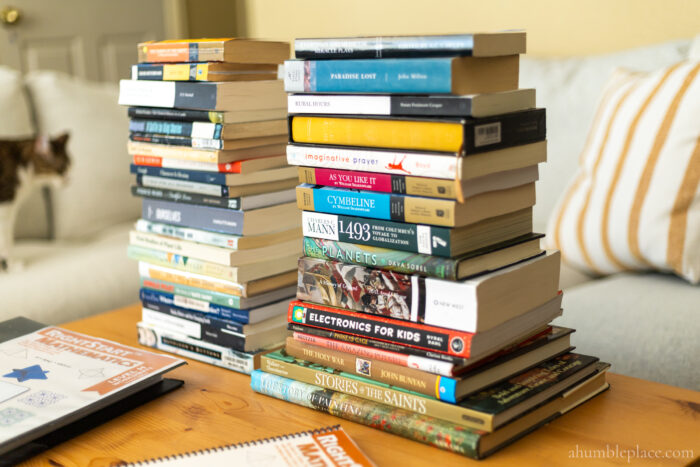
As I noted in my planning post, I chose Mann’s 1493 for Young People for Term 1, which B read on his own. It was a great choice and we both found it very interesting, but it was also too much to cram into one term. There were a few weeks where he was reading 50 pages from this book alone, which was not a great plan. In hindsight, I should’ve split this one out more evenly with Kon-Tiki, which we read in Terms 2 and 3 and generally had shorter readings.
He also read Kon-Tiki on his own, and we both found this one interesting as well. I didn’t like it as much as The Brendan Voyage from Year 7, but I appreciated that this one exposed us to a different part of the world and completely different cultures. We might watch the documentary on Kon-Tiki at some point.
I also printed several maps at the beginning of the year for us to fill out in various subjects as we made our way through the books, but only managed to use a few of them. Map activities continue to be a thorn in my side in terms of how to include them in the schedule so they actually get done, and I’ll have to rethink this yet again for the coming school year.
Citizenship
Citizenship Book List Here
Plutarch Schedule Here
Plutarch Resources
Plutarch Maps
B read this year’s excerpt from Ourselves on his own, and we’ve had some good discussions, so I think this way is working fine. However, I spoke with a few friends who have sons the same age, and they mentioned reading it with their boys, so that’s something we might try next year. I think it’s just such an excellent book and full of so much wisdom that I don’t want to pass through it quickly.
Government and Economics
The Richard Maybury books continue to be such a refreshing change to the government and economics books I had in school. While I don’t agree with everything he says, I think he does shed light on very important and controversial topics that are not often addressed even outside of a school setting. B read this one on his own, but we had good discussions about it.
Current Events
World Teen News (and PrintFriendly browser extension)
The World from A to Z with Carl Azuz (we watch it through YouTube on our Roku)
I continued to print two stories per week from World Teen News, and he chose at least one of them from which to write a narration (the other one was verbally narrated). I was also considering subscribing to World Watch for us to watch together, as a few friends are big fans. However, about halfway through the year, another friend mentioned The World from A to Z with Carl Azuz, which is free on YouTube. We decided to give it a try and have been hooked ever since. It was the last thing we did during our morning lesson time, and everyone in the family, even my husband, looked forward to watching it every day. We’ll be glad when he returns next month!
Science
Science Book List Here
All Three Terms: Sabbath Mood Homeschool Form 3-4 Botany Living Science Guide
Term 1: Sabbath Mood Homeschool Form 3-4 Astronomy Living Science Guide
Term 2: Sabbath Mood Homeschool Form 3-4 Engineering & Technology Living Science Guide
Term 3: Sabbath Mood Homeschool Form 3-4 Geology Living Science Guide
Various books from the Sabbath Mood Homeschool living science books lists
Cognitive Surplus Notebooks
Science Resources
Since Form 2, science has been the subject where we deviate the most from the AO schedule, but I think this was a good path for us. I needed something more structured and fleshed out for my tech/science-minded son, and the Sabbath Mood Homeschool guides, for the most part, worked extremely well for us. We had some problems with some of the experiments not working as described (which may also have been due to user error), but the layout of the lessons, the books chosen, and most of the experiments were just right for us. I appreciated how they also eased him into becoming more of a self-learner as we did the lessons together in Form 2, but Form 3 was designed for him to do on his own. I also LOVE the science notebooks we now have from the last two years. I got to see his personality shine in his hand-written narrations and drawings in these notebooks, and I will always treasure them.
Of all the SMH science guides we’ve done over the last five years, the Form 3-4 Engineering and Technology book was his favorite. This isn’t a surprise as he started using SnapCircuits when he was six, graduated to LEGO Mindstorms later, and we got him an Arduino kit this last Christmas per his request. Electronics and programming are just his bent. But it was gratifying for him to have something that he was reading about for school in which he has a genuine interest. He doesn’t slack in his other subjects, but, as is the case with any of us, it was a lot more enjoyable for him to learn more (or at least read in more detail) about something he enjoys.
For the other subjects we covered, he claims he did not care for botany, but the experiments that required him to grow seedlings sparked an interest in him that eventually led to him deciding he wanted to be in charge of our garden this year. The science of relations at its best! It also reminds me of this quote from a pamphlet from the PNEU about examinations:
Apart from the ‘work,’ the teacher or parent is asked to reveal the child’s interests and hobbies and give some indication of his or her personal development. These help the examiner to arrive at a picture of the child ‘in the round.’ It is in the child as a person that we are interested. The mind is only an instrument of the self and develops step by step with the whole development of man.
For the AO books, he read Napoleon’s Buttons, Great Astronomers, and Phineas Gage on his own, and we watched the Chemical History of a Candle lectures together (which he really enjoyed!). Of these, I think Napoleon’s Buttons was the most challenging to get through. It was interesting, but at times, it was hard to follow how he broke down the chemical structures (even though there are diagrams) and how different chemicals relate to each other. It was, however, neat to see some of the things we read in 1493 for Young People show up in this book also. He also read First Studies of Plant Life on his own, but that was part of his SMH Botany study, so we used a different reading schedule.
Because we also did the other SMH guides, we skipped Adventures with a Microscope, the Johannes Kepler biography, Signs and Seasons, and the William Harvey book. We started to read A Briefer History of Time, but I decided to pause on that one and may include it in Year 9 when he’ll be studying physics.
Nature Study
Nature Study Book List and Recommendations Here
AO Nature Study Schedule
Ambling Together Nature Study Guides
Nature Study Collective
Nature Study Resources
I followed the AO schedule for nature study, but Terms 1 and 2 were definitely better than Term 3. I used the Ambling Together guides for Terms 1 (cultivated crops) and 3 (insects), and then the Nature Study Collective for Term 2 (weather), as we’ve studied weather several times before, and I wanted something a little lighter for that term. For the most part, the Nature Study Collective guide worked well for us as a way to keep us focused on our nature study subject, but quite a bit of it was review (as I’ve mentioned, we’ve studied weather several times before). I really do like the layout of the book and the lessons, and I think if the topic is one that you haven’t studied before, it’s a great resource.
Term 3 was just challenging as it felt like we were behind a lot, so a few things fell by the wayside, including Nature Study. I justified this partially because we did object lessons with our weekly hiking group, but I definitely dropped the ball on our insect study.
I also modified Rural Hours in that I included it in our Morning Time and just read the entries that matched the dates of the current week. We didn’t get through the entire book, but we did cover quite a bit of it.
Math
RightStart Level G
RightStart Level H
Math Resources
He is still working through the last few lessons of RightStart Level H this summer, and then we will be completely done with RightStart. It’s been a great math program for us and, for the most part, has explained all the different math concepts to him in a way he has been able to understand and master. I am very interested to see how he does as we switch to Art of Problem Solving, one of the recommended high school math curricula on the RightStart website, in the fall, as, besides kindergarten, RightStart is the only math curriculum we’ve ever used.
Logic
We also ended up dropping How to Read a Book. It was interesting, but didn’t particularly resonate with him at this age, and I needed to cut back. I may revisit it with him when he’s older, as I do think it offers great ideas.
Art
Art Book List and Recommendations Here
Art Resources
We continued to plod along through The Story of Painting throughout the year. In Term 3, I divided the material more evenly, assigning a little bit each week. I think this helped him retain more information, so I plan to do the same next year.
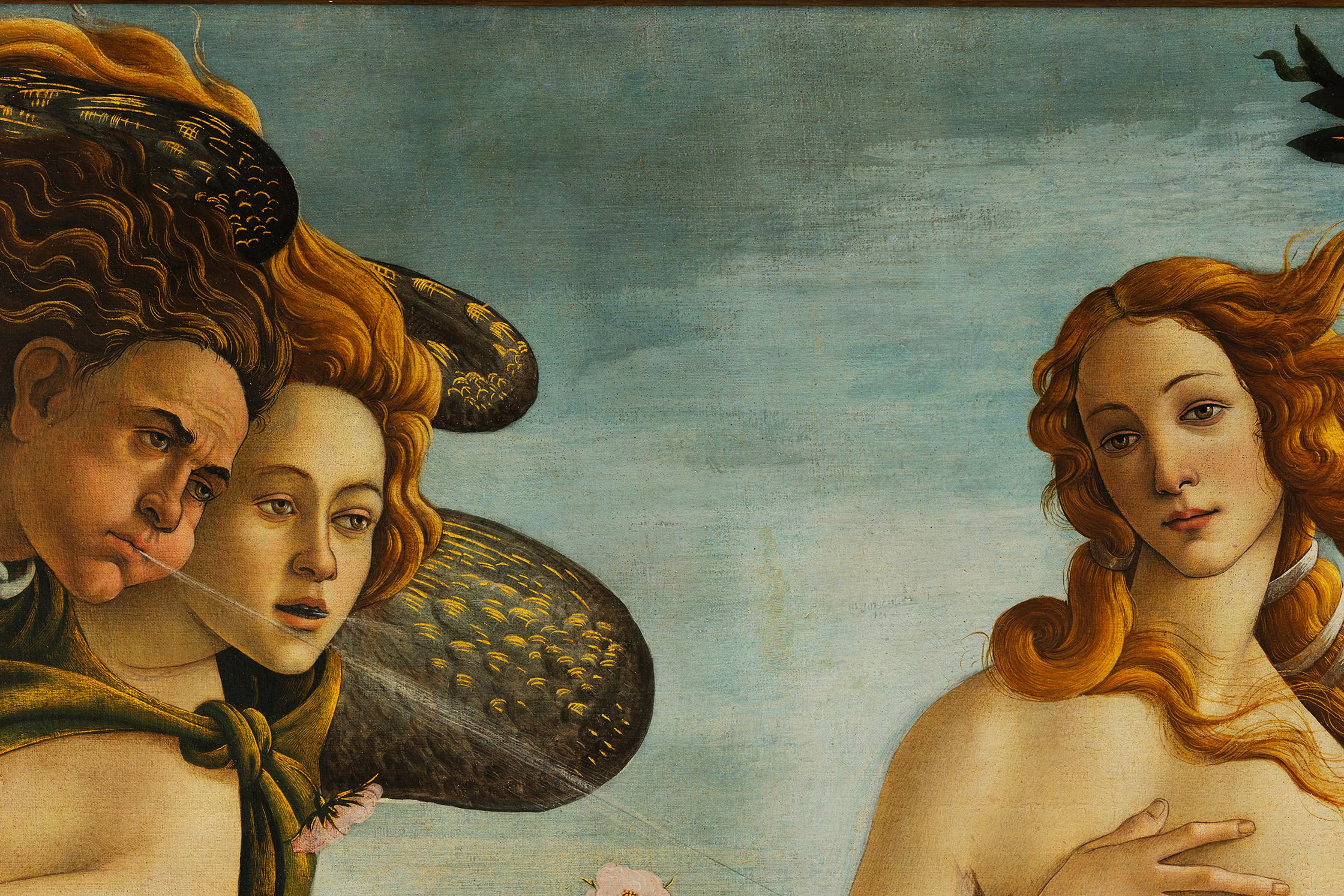
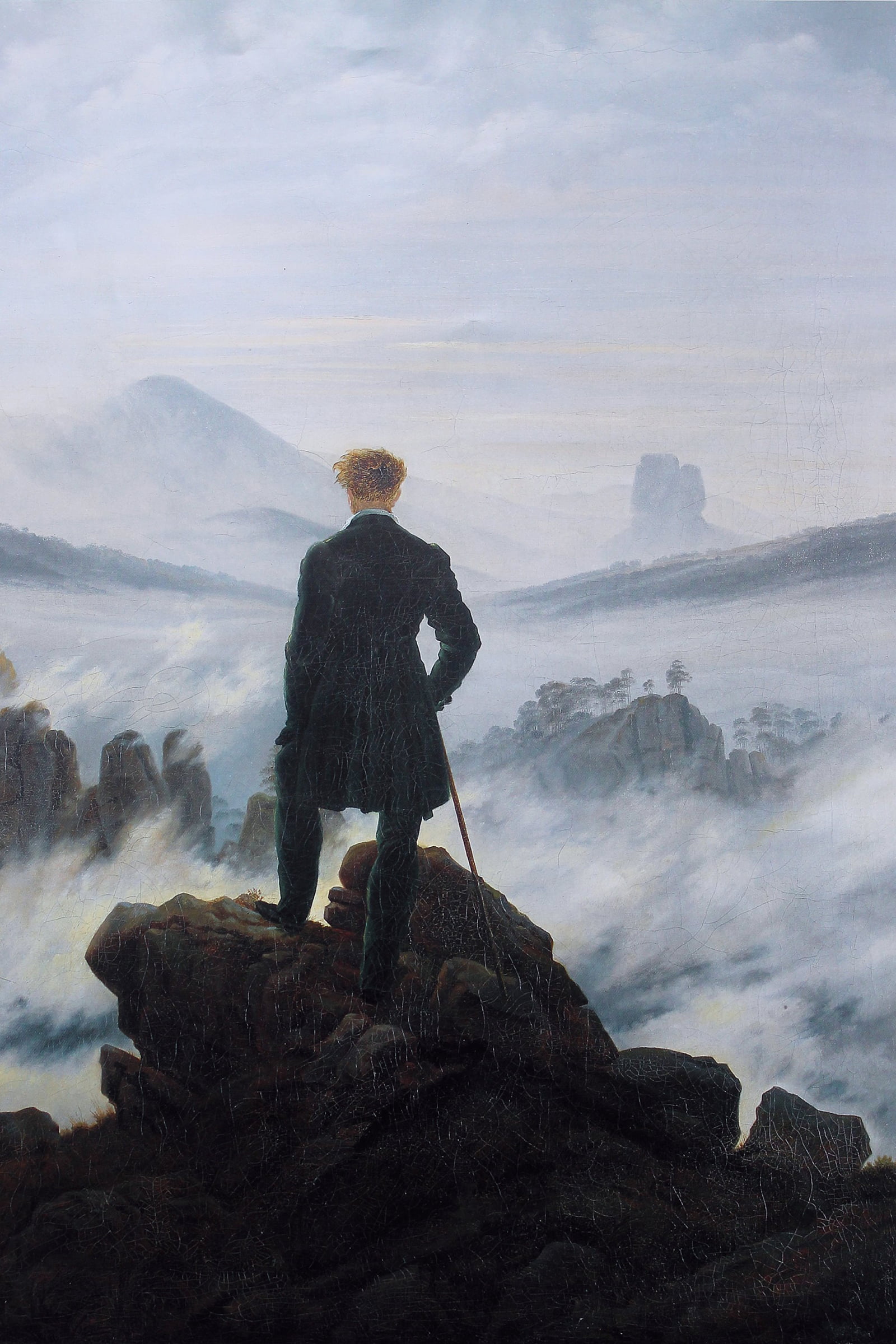
Picture Study
Term 1: Albrecht Dürer
Term 2: Caravaggio
Term 3: Rosa Bonheur
I was excited for this year’s artists, as Albrecht Dürer is a favorite, and I’ve always been fascinated by Caravaggio. Instead of Eugéne Delacroix, I opted to introduce them to Rosa Bonheur. I knew my daughter would especially like her as she was all about animals!
Drawing
Lily and Thistle Nature’s Art Club
This was another subject that fell by the wayside as the year progressed. We managed to complete a few lessons and started using colored pencils, but we’re not nearly as far along as I planned. I am still very impressed by this course, though, and so glad I picked it up for us as the lesson length is just right, and I can definitely see improvement in their drawing abilities!
Music
Composer Study
Composer Study Schedule Here
Tillberry Table Beethoven Composer Study Guide
Book of Composers
Tillberry Table Chopin Composer Study Guide
Composer Study Resources
For our composer study, I used the Tilberry Table guides for Terms 1 and 3, which, as always, were so helpful! In Term 2, I used the Book of Composers from Beautiful Feet Books to make my own study as they had sent it to me last year and I wanted to try using it for our composer study time. The information in the book, along with the resources it came with, was very helpful, and we enjoyed learning more about Vivaldi. I think it is a great overview of many different composers and would be a great book to have on hand for reference.
Hymn/Folksong
Hymns
Term 1: Glorious Things of Thee Are Spoken & Come Ye Thankful People Come
Term 2: How Great Thou Art & Trust and Obey
Term 3: Guide Me, O Thou Great Redeemer & Come Thou Fount of Every Blessing
Folksongs
Term 1: The Gypsy Rover & I’se the B’y
Term 2: Sussex Carol (for Christmas) & Keys to Canterbury & All Through the Night
Term 3: (we continued All Through the Night in the first half of the term) & When You and I Were Young, Maggie
These were the hymns and folksongs we ended up learning this year (I only do two per term rather than the three that AO schedules as we began this habit with our old homeschool co-op and it stuck). We enjoyed them all!
Health and Physical Education
Health and Physical Education Book List Here
We ended up joining a local weekly homeschool hiking group with some other Charlotte Mason families last August (after I wrote my planning post), and the weekly hikes, which average about 3 miles, were an excellent form of physical activity for us this year. We’ll be continuing that into the foreseeable future.
We also read Fearfully and Wonderfully Made, which I had put off reading last year because I was concerned about content, but it was so, so, so good. I’m very glad I didn’t skip it entirely, as I had thought about doing. I highly recommend it! (Definitely read the notes for it, though, before handing it to your kids!)
Life and Work Skills (or Handicrafts)
As I mentioned above in Science, B decided to take over managing our garden this year, so the last half of the school year involved a lot of planning for that. He has saved many seeds over the last few years from plants we’ve grown or produce from either the grocery store or our CSA, so he started many seedlings in the house in the spring and then transplanted them (along with a few starts from Azure Standard for the seeds we didn’t have) into the garden in May per the schedule we generated through Seedtime. He also installed an automated irrigation system and put up row covers. It’s been hit-or-miss, which is always how it is here in Colorado when trying to grow anything, but it’s the best garden we’ve had in years, and I was very pleased with the initiative and the excitement he showed in this task. Hopefully, it gives him a lifelong love of gardening.
Free Reads
Year 8 Free Reads Book List Here
The only book we got to on the Free Reads list was Freckles. I didn’t realize this until recently, so we obviously have some reading to do this summer!
And that was year 8! I now have a high schooler! I will try not to cry…
Enter your email address here to get updates and exclusive downloads, including a free Picture Study Aid!
(If the form is not loading for you, you can also sign-up here!)


This is a lot and even if you didn’t get to everything, you and B should be very proud!
Thank you for your encouragement!
Congratulations on your journey to high school! I continue to enjoy following along with your learning, so thank you for sharing. My sons (especially my 2nd son) really loved the electronics sabbath mood guide also. He then moved on to Make by Charles Platt for more projects if that is an ongoing interest for your son.
And good luck on your transition to Art of Problem Solving. We have loved their curriculum for many years but it is a lot of content. I was interested to see that when my oldest son took some of the courses with their instructors, they only assigned 10 or so problems per chapter at times. They also used their online learning resource ALCUMUS for homework and my son used it to master Precalculus this past year. It can be motivating for some students to level up and after completing a problem they will see full solutions.
Thank you for the Platt book recommendation, Jen! I just reserved it at the library. I was thinking AoPS is going to be a lot of content for us as well, so that’s interesting to know about just ten problems. I’m going to try to keep an open mind about it and just see how it goes at first. He really enjoys problem solving and I think the lessons that I’ve seen in the book seem to be written in less of a textbook-y way than RS has been. He is also interested in the Game of Life challenges at the beginning of each chapter. I have looked at ALCUMUS and I find it interesting that they used that for homework. I might see how that can be used in a setting where we are not actually taking the course but using the book. Thank you for the ideas!
I’m always so thankful you take the time to document your year and specific reactions to books. I come back to them again and again when I’m planning my years (Y3 and a new Y1 this fall). Your posts remind me each child is different and we may not get “everything” done, but the education and relationship we gain is still a thing of wonder, by God’s grace.
I’m so glad to heat my posts have been helpful to you, Joanna! I really love to hear how other people do their own homeschool journey as it helps me come up with ideas for ours. 🙂
Hello,
We love AO – my older boys did Ambleside before there were even written schedules. Now I’ve only got one dd to go and this year we finished Year 8. I have So enjoyed reading all your tips and I have picked up some gems over the last years from your generous posts.
We did slog through Westward Ho – was it worth it? Sorta, maybe, uh, not sure. A bit of a anti-climactic ending. BUT we loved I Promessi. As long of a read as it was, it was a pleasant read and it ended up being a favorite because the bad guys did get their comeuppance.
I have been deep into planning Year 9 for the past month. It’s so hard to say no to some books. Can’t wait to see what you are planning. Your posts have been a blessing to us. Thanks so much.
I’m so glad my posts have been helpful, Cathy! And thank you for sharing your thoughts on “Westward Ho!” and “I Promessi Sposi.” It’s interested to hear how books were hits or misses with other families. Maybe one of these years we will try them as free reads. 🙂
I would love to hear more about how you fit SMH Astronomy into one term, and just any details or tips you could share on that one in particular. I’ve been planning on using Signs and Season with my Y8 and Y7 per the AO schedule but we failed miserably last year with the field work; I’m wondering if the the organization and “scheduled-ness” of the SMH would help us actually get it all done. So yes… just eager to hear your thoughts.
Nicole actually has two different schedules in her Form 3-4 books for either doing the book over the course of one year, or doing it in a term. For one term, it works out to 3 lessons per week for 11 weeks, which was very doable for us even with the added year-long science study. The Form 3-4 astronomy guide doesn’t have a lot of actual “field work.” It’s more activities related to reading Dava Sobel’s “The Planets.” But her Form 2 astronomy guide definitely has you getting outside at night a lot more, if that’s helpful at all!