Rosa Bonheur Picture Study Aid and Art Prints for Homeschoolers

My whole life has been devoted to improving my work and keeping alive the Creator’s spark in my soul. Each of us has a spark, and we’ve all got to account for what we do with it.
Rosa Bonheur
When I began taking my art history classes in college, I had never heard of Rosa Bonheur. This is not uncommon. There were many artists to whom I was introduced in those darkened lecture halls that I may never have known about if I hadn’t switched my major to art history in my freshman year. And I am truly thankful for this!
All of my art history classes followed a similar format. The professor connected his or her laptop to an overheard projector via miscellaneous cords erupting from the lectern (these were the dark ages before Bluetooth), lowered the lights in the room (or asked a student to do it), and suddenly on the screen in front of us was a massive work of art from whatever time period we happened to be studying.
It was always a little exciting when it was time to switch to a new piece because we never knew what we were going to get. Sometimes it was something familiar that was covered in our initial survey classes. Sometimes it was something surprising, like another painting by a familiar artist that we had never seen before. And sometimes, it was something that caught your breath.

The Horse Fair caught my breath. One of the many signs of a skilled artist is their ability to capture movement. Movement is not easy. Sometimes it can seem a little stiff and disjointed; a foot or shoulder is at an odd angle, and you can’t quite figure out how that person or animal is really supposed to be moving.
Good artists do it well, but the best artists make it seem as if the painting really is moving before your eyes. And that’s what Rosa Bonheur did in The Horse Fair. There is prancing. There is jumping. There is neighing. There is yelling. There is wind. There are rumbles in the ground from hoofs. There is so much movement, and it’s all wrapped up in one monumental swirl of paint.
Bonheur dedicated her life to painting, and not only the art of painting, but more specifically, the art of painting animals. She adored animals, and this is evident in the care and attention to detail she used when putting them on canvas. At a time when wild animal ownership was accepted, she kept a menagerie at her home and spent her days interacting with and painting the animals in her care. She studied their musculature, organs, and body structure the same way Leonardo da Vinci and Michelangelo studied humans. Painting was most certainly a passion for her, but animals were unquestionably just as important.

Rosa Bonheur Picture Study Aid and Art Prints
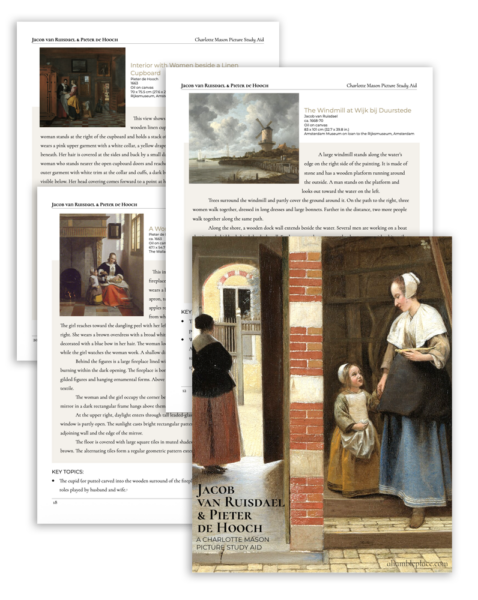
I’m excited to announce that I have a new Picture Study Aid covering the art of Rosa Bonheur, along with accompanying fine art prints, now available! Included in this 29-page Picture Study Aid is a summary of the life and artistic inspirations of the French Romantic painter Rosa Bonheur (1822-1899), key topics for seven of her works (see below), printable versions of the pieces covered in the PDF version, and a brief discussion about Charlotte Mason’s ideas and methods for implementing picture study at different ages.
The pieces discussed are*:
You can also find books for further reading about Rosa Bonheur in the Living Art Book Archive.
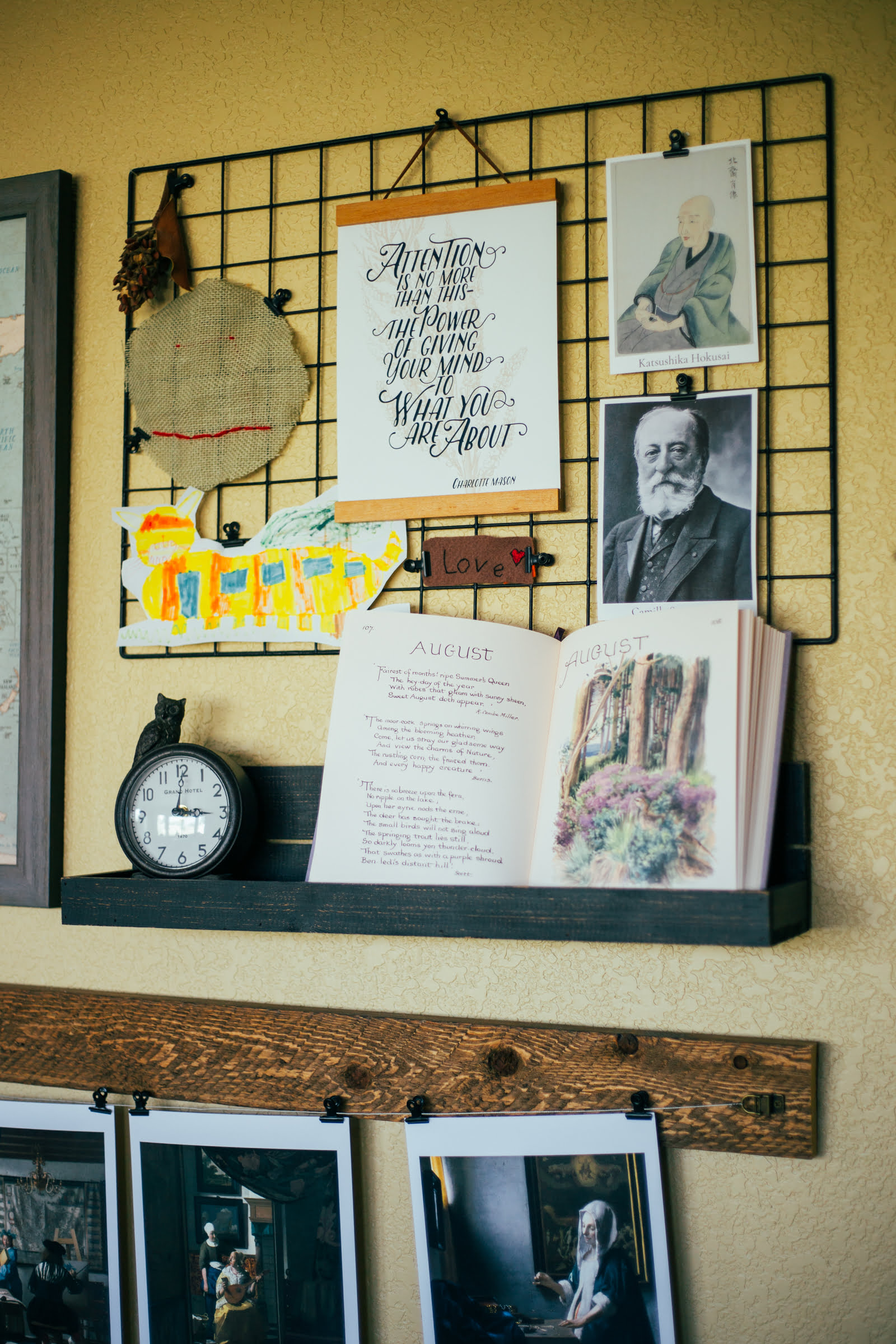
I include a brief overview of Charlotte Mason picture study at the beginning of the Picture Study Aid; however, I have also written posts here on the blog about why it is important and how we incorporate it into our home and homeschool co-op.
You can get your copy at the link at the end of the post!
Caveats
This guide is by no means an exhaustive analysis or study of each piece, which is intentional. I tried to keep it all very simple in the spirit of there being:
…no talk about schools of painting, little about style; consideration of these matters comes in later life, the first and most important thing is to know the pictures themselves. As in a worthy book we leave the author to tell his own tale, so do we trust a picture to tell its tale through the medium the artist gave it. In the region of art as else-where we shut out the middleman.
CHARLOTTE MASON (VOL 6 PG 216)
Instead, this Picture Study Aid is meant to offer basic information about the artists as well as ready answers should your student ask about a particular aspect of a piece and the explanation isn’t readily evident. Ms. Mason emphasized not focusing on strict academic discourse when doing picture study but rather simply exposing students to the art itself:
His education should furnish him with whole galleries of mental pictures, pictures by great artists old and new;––…––in fact, every child should leave school with at least a couple of hundred pictures by great masters hanging permanently in the halls of his imagination, to say nothing of great buildings, sculpture, beauty of form and colour in things he sees. Perhaps we might secure at least a hundred lovely landscapes too,––sunsets, cloudscapes, starlight nights. At any rate he should go forth well furnished because imagination has the property of magical expansion, the more it holds the more it will hold.
CHARLOTTE MASON (VOL 6 PG 43)

Enter your email address here to get updates and exclusive downloads, including a free Picture Study Aid!
(If the form is not loading for you, you can also sign-up here!)